
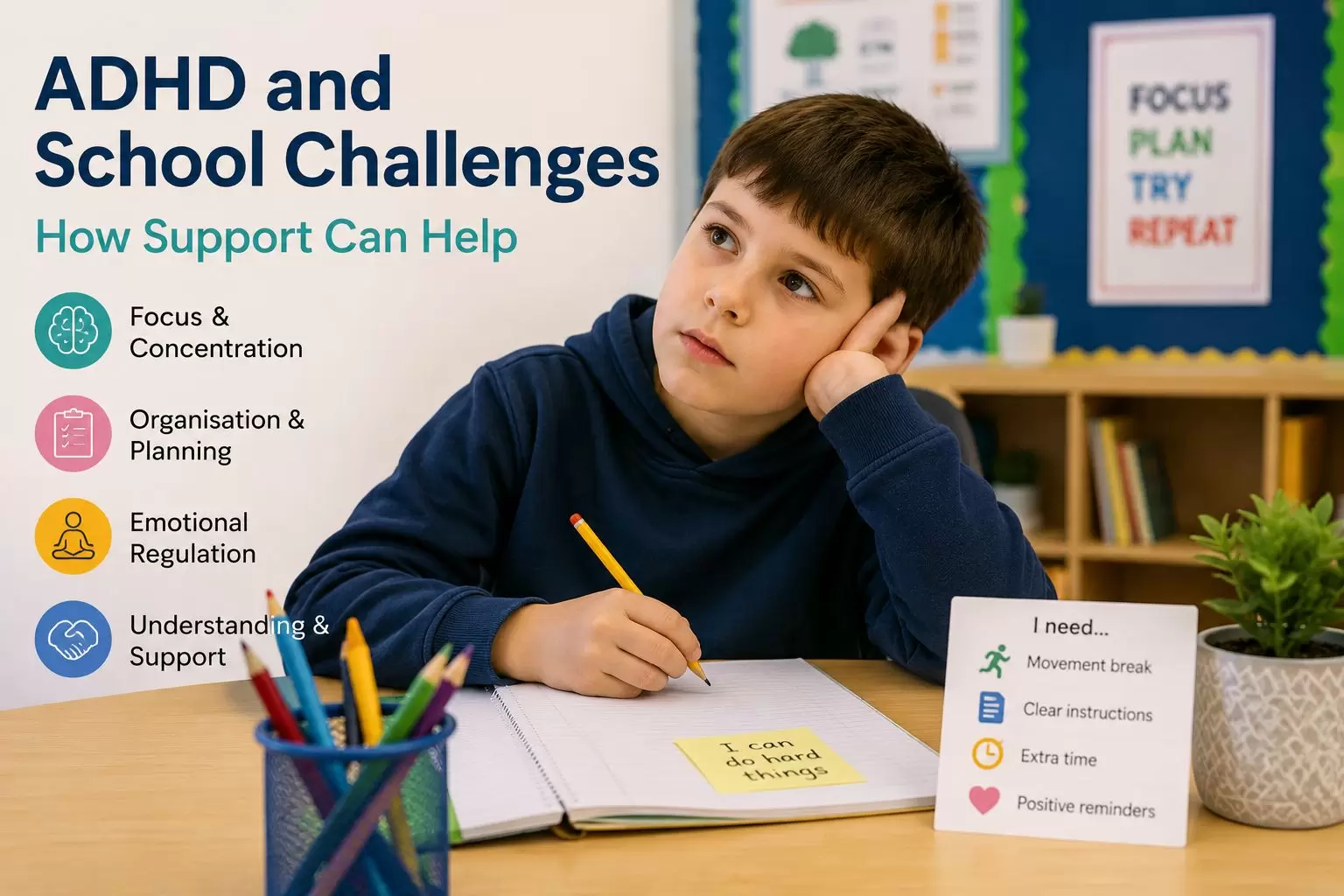
ADHD and School Challenges: How Support Can Help
ADHD can affect how a child concentrates, manages emotions, follows instructions, organises tasks, and copes with the demands of the school day.
For some children, school can feel exhausting. They may want to do well, but find it difficult to sit still, stay focused, wait their turn, or complete tasks in the same way as their peers.
With the right support, children with ADHD can thrive. The key is understanding what is driving the difficulty and making practical adjustments that work.
How ADHD Can Affect Learning
ADHD can affect learning in different ways.
Some children may struggle with:
- Staying focused during lessons
- Starting or finishing tasks
- Remembering instructions
- Organising books, equipment, and homework
- Managing time
- Sitting still for long periods
- Controlling impulses
- Regulating emotions
- Coping with transitions
These difficulties are not a sign that a child is lazy or not trying. ADHD affects executive functioning, which includes planning, attention, organisation, self-control, and working memory.
Common ADHD Challenges in School
Children with ADHD may experience school as a place full of competing demands.
They might be expected to listen, sit still, copy from the board, remember instructions, manage friendships, and complete work within set time limits.
Common challenges include:
Difficulty Concentrating
A child may find it hard to stay focused, especially during long explanations or tasks that do not feel engaging.
Impulsivity
They may call out, interrupt, move around, or act before thinking. This can sometimes be misunderstood as deliberate behaviour.
Organisation Difficulties
Children with ADHD may forget homework, lose equipment, miss instructions, or struggle to plan multi-step tasks.
Emotional Regulation
Small frustrations can feel overwhelming. A child may become upset, angry, withdrawn, or anxious when demands feel too much.
Low Confidence
Repeated criticism or negative feedback can affect self-esteem. A child may begin to believe they are “naughty” or “not good at school.”
Why ADHD Is Often Misunderstood
ADHD is sometimes seen only as hyperactivity, but it can look very different from child to child.
Some children are visibly restless. Others may appear quiet but struggle internally with focus, overwhelm, or anxiety.
A child with ADHD may be described as:
- Distracted
- Disruptive
- Forgetful
- Careless
- Defiant
- Overemotional
- Unmotivated
In reality, these behaviours may reflect unmet needs.
Understanding ADHD through the lens of support, not blame, can change the whole experience of school for a child.
What Support Can Help Children With ADHD?
Support should be practical, consistent, and matched to the child’s needs.
Helpful strategies may include:
- Short, clear instructions
- Visual reminders
- Movement breaks
- Seating away from distractions
- Chunked tasks
- Extra time to process information
- Regular check-ins
- Help with organisation
- Positive reinforcement
- Emotional regulation strategies
- Quiet spaces when overwhelmed
Support works best when staff understand the child’s needs and use strategies consistently.
ADHD and SEN Support
Many children with ADHD receive help through SEN support.
This may include targeted interventions, classroom adjustments, and regular monitoring by the SENCO.
SEN support may be enough if your child is making progress and coping well.
However, if your child continues to struggle despite support, it may be worth considering whether a more formal plan is needed.
You can explore this further in SEN support vs EHCP.
When Might a Child With ADHD Need an EHCP?
Not every child with ADHD needs an EHCP.
An EHCP may be appropriate if your child’s needs are significant, ongoing, and require support beyond what the school can provide through SEN support alone.
You may want to consider an EHCP assessment if:
- Your child is not making progress
- Behaviour is affecting learning or attendance
- Anxiety or emotional distress is increasing
- Support is inconsistent
- Specialist input is needed
- Your child needs structured support across the school day
If you are unsure, read signs your child may need an EHCP for more guidance.
ADHD and Emotional Regulation
Emotional regulation can be one of the biggest challenges for children with ADHD.
A child may react strongly to situations that seem minor to others. This does not mean they are overreacting on purpose. It may mean they are struggling to manage intense feelings in the moment.
Support may include:
- Calm scripts from adults
- Safe spaces
- Predictable routines
- Emotion coaching
- Reduced shame after incidents
- Clear repair conversations
- Visual regulation tools
You can also read emotional regulation in school for more practical strategies.
What Evidence Can Help When Seeking Support?
If you are asking for more support, evidence can help show what your child needs.
Useful evidence may include:
- School reports
- Behaviour logs
- SEN support plans
- Examples of unfinished work
- Notes about emotional distress
- Attendance records
- Professional assessments
- Parent observations
The aim is to show patterns clearly, not just isolated incidents.
Questions to Ask Your Child’s School
If you are concerned about ADHD-related challenges, you may want to ask:
- What support is currently in place?
- How is my child’s progress being monitored?
- Are instructions being adapted?
- Are movement breaks available?
- What happens when my child becomes overwhelmed?
- How are staff supporting organisation?
- Is further assessment needed?
These questions help move the conversation toward practical support.
Frequently Asked Questions: ADHD and School Support
How does ADHD affect children in school?
ADHD can affect focus, organisation, impulse control, emotional regulation, working memory, and task completion. This can make the school day more demanding.
Can a child with ADHD get SEN support?
Yes, children with ADHD can receive SEN support if their needs affect learning, behaviour, emotional wellbeing, or access to education.
Does ADHD qualify for an EHCP?
ADHD can be part of an EHCP application if the child’s needs are significant and require support beyond what the school can usually provide.
What classroom support helps children with ADHD?
Helpful support can include visual instructions, movement breaks, chunked tasks, reduced distractions, extra processing time, and regular adult check-ins.
Can ADHD affect behaviour at school?
Yes, ADHD can affect behaviour, especially where a child struggles with impulse control, frustration, attention, or emotional regulation.
What if the school says my child just needs to try harder?
ADHD is not a lack of effort. It affects executive functioning. If your child is struggling, ask what adjustments are being made and how progress is being monitored.
When should I request an EHCP assessment for ADHD?
You may want to request an assessment if your child is not making progress, support is not working, or their ADHD is significantly affecting learning, wellbeing, or attendance.
Final Thoughts
Children with ADHD can succeed in school when their needs are understood and support is consistent.
The goal is not to remove expectations. It is to make those expectations accessible, realistic, and supported.
If you want to understand how ADHD support connects with SEN support and EHCPs, you can explore our comprehensive EHCP guide, which explains each stage in detail.