
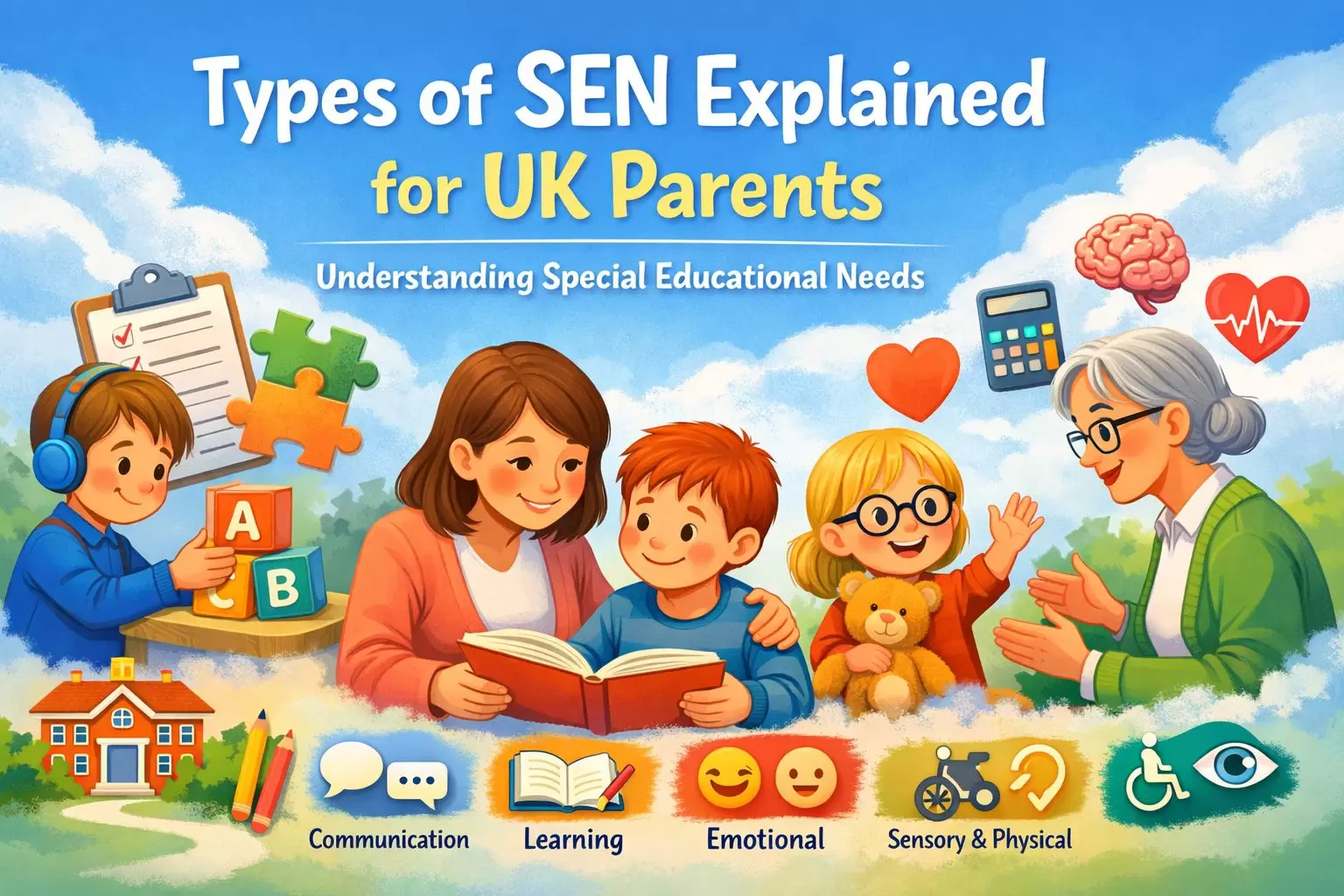
Types of SEN Explained for UK Parents
A clear, compassionate guide to understanding Special Educational Needs
When your child is struggling at nursery, school, or college, it can be worrying, confusing, and sometimes overwhelming. Many parents hear the term Special Educational Needs (SEN) but aren’t always given clear explanations about what it really means or how it applies to their own child.
This guide is written for UK parents who want a thorough, friendly explanation of the different types of SEN, how they are grouped, and what support may be available. Whether you’re just beginning to ask questions or already navigating the system, this article aims to give you clarity, confidence, and reassurance.
What Does SEN Mean in the UK?
In the UK, a child or young person is considered to have Special Educational Needs (SEN) if they have a learning difficulty or disability that means they need additional or different support compared to most children of the same age.
This definition comes from the SEND Code of Practice, which applies in England and is widely referenced across the UK. SEN can affect how a child learns, communicates, behaves, or interacts with the world around them.
It’s important to remember:
SEN is not a diagnosis
SEN does not reflect intelligence or potential
Many children with SEN thrive when the right support is in place
Why SEN Is Grouped into Categories
To make it easier for schools and professionals to identify needs and plan support, SEN is divided into four broad SEN categories. These categories help describe areas of need, not labels for children.
A child may fit into one category, more than one, or move between categories as they grow and develop.
Understanding these SEN categories can help parents:
Communicate more effectively with schools
Understand reports and assessments
Advocate confidently for appropriate support
The Four Main SEN Categories in the UK
1. Communication and Interaction
This category includes children who have difficulty communicating with others or understanding language.
Children with communication and interaction needs may:
Struggle to express themselves verbally
Find it hard to understand spoken instructions
Have difficulty with social interaction or forming friendships
Misinterpret tone, facial expressions, or social rules
Common SEN conditions UK parents may hear about in this category include:
Autism Spectrum Condition (ASC)
Speech, Language and Communication Needs (SLCN)
Developmental Language Disorder (DLD)
Support may include speech and language therapy, visual aids, structured routines, or social skills support.
2. Cognition and Learning
This category covers difficulties with learning, thinking, and processing information.
Children with cognition and learning needs may:
Learn at a slower pace than their peers
Struggle with reading, writing, spelling, or maths
Find it hard to remember instructions or apply skills independently
Need learning broken down into smaller steps
Examples of SEN conditions UK schools often identify here include:
Dyslexia
Dyscalculia
Dysgraphia
Moderate Learning Difficulties (MLD)
Severe or Profound Learning Difficulties (SLD/PMLD)
Support often includes differentiated teaching, targeted interventions, assistive technology, and extra time.
3. Social, Emotional and Mental Health (SEMH)
Some children struggle not with learning itself, but with managing emotions, behaviour, or mental health.
Children with SEMH needs may:
Experience anxiety or low self-esteem
Display challenging or withdrawn behaviour
Have difficulty regulating emotions
Struggle to cope with change or pressure
SEN conditions UK parents may encounter within SEMH include:
Attention Deficit Hyperactivity Disorder (ADHD)
Anxiety disorders
Attachment difficulties
Trauma-related needs
Support may include emotional literacy programmes, mentoring, behaviour support plans, or access to mental health services.
4. Sensory and/or Physical Needs
This category includes children with physical disabilities or sensory impairments that affect access to learning.
Children may have:
Hearing impairment
Visual impairment
Physical disabilities
Sensory processing difficulties
They may need:
Specialist equipment or adaptations
Physical support or therapy
Modified learning environments
Assistive technology
Many children with sensory or physical needs are academically capable but require adjustments to fully participate in school life.
Can a Child Have More Than One Type of SEN?
Yes — and many do.
It’s very common for children to have overlapping needs across different SEN categories. For example:
A child with autism may also experience anxiety (SEMH)
A child with dyslexia may struggle with self-esteem
A child with physical needs may also have communication difficulties
This is why support should always be individualised, focusing on the child rather than just the category.
SEN Conditions UK Parents Commonly Ask About
Parents often search for specific diagnoses when trying to understand SEN. While diagnoses can be helpful, support does not depend on having one.
Some commonly discussed SEN conditions UK families encounter include:
Autism Spectrum Condition (ASC)
ADHD
Dyslexia
Dyspraxia (DCD)
Speech and Language Disorders
Sensory Processing Differences
Schools are legally required to support children based on need, not diagnosis.
What Support Is Available for Children with SEN?
Support for SEN can include:
Classroom adjustments
Targeted small-group interventions
Specialist teaching or therapy
SEN Support Plans
Education, Health and Care Plans (EHCPs) for more complex needs
As a parent, you have the right to:
Be involved in decisions
Ask for assessments
Request meetings with the SENCO
Seek independent advice and support
Reassurance for Parents
Learning that your child has SEN can bring mixed emotions — concern, relief, uncertainty, and hope all at once. It’s important to remember:
SEN is far more common than many parents realise
Early understanding leads to better outcomes
You are not alone
Your child’s strengths matter just as much as their needs
With the right support, children with SEN can and do flourish.
Final Thoughts
Understanding the types of SEN, the SEN categories, and the range of SEN conditions UK families encounter is a powerful first step. Knowledge gives you confidence — and confidence helps you advocate for your child.
If you ever feel unsure, asking questions is not a sign of weakness. It’s a sign of strong parenting.