
What the proposed four-tier SEND system would mean for families
Under the government’s planned changes to SEND support (expected to be explained in a future Schools White Paper), children and young people with SEND would move through a series of support levels before they could get an Education, Health and Care Plan (EHCP).
At the moment, an EHCP is the main way to legally guarantee support. Under the proposals, EHCPs would be harder to get and used only for children with the most complex needs, after other support options have been tried first.
The main changes being proposed
🔹 Digital “support passports”
Every child with SEND would have a digital record (sometimes called a “passport”) that explains:
their needs
what support they receive
what has and hasn’t worked
This record would move with the child as they change schools or settings, so parents don’t have to keep starting again or repeating their child’s story.
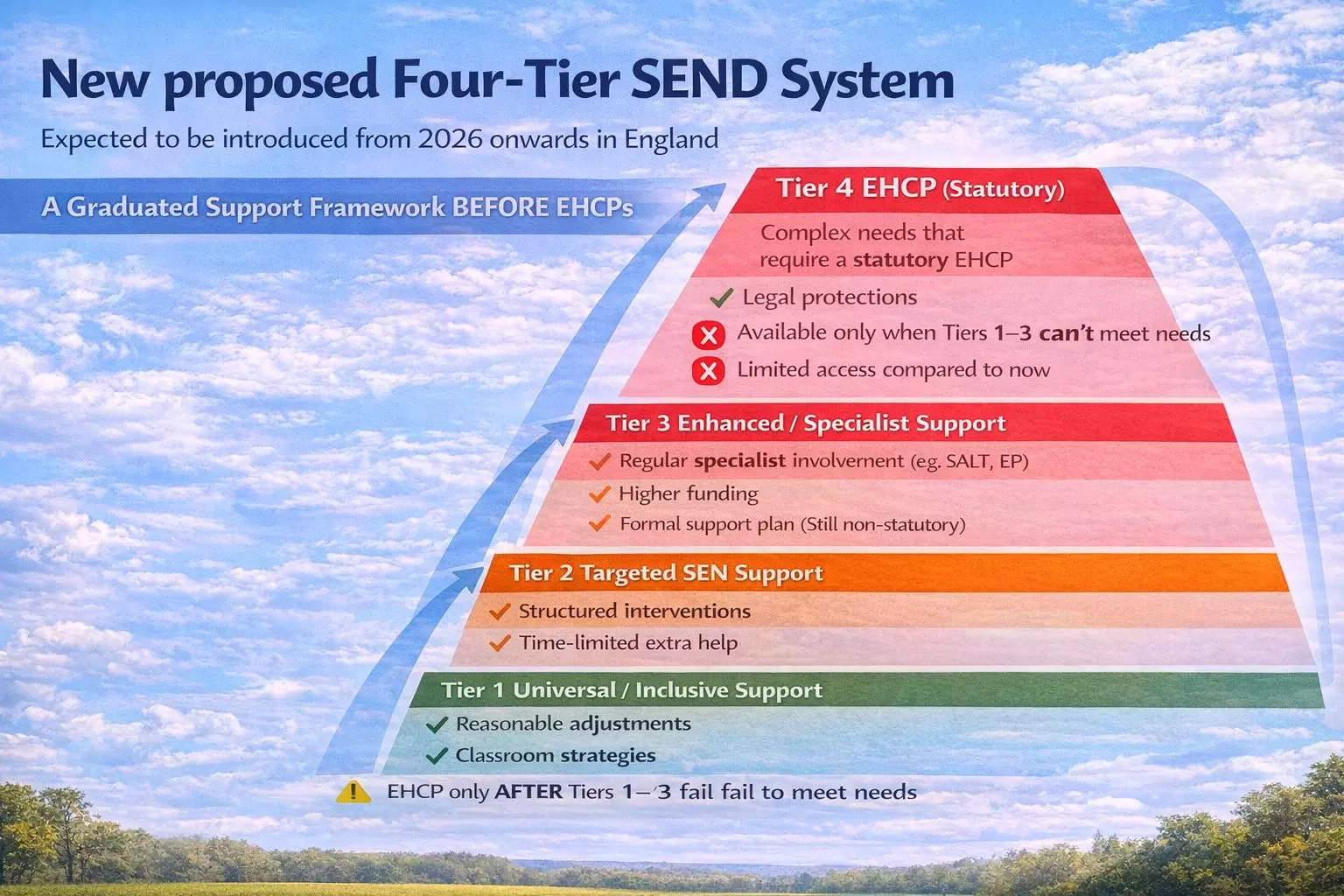
🔹 Four levels of support before an EHCP
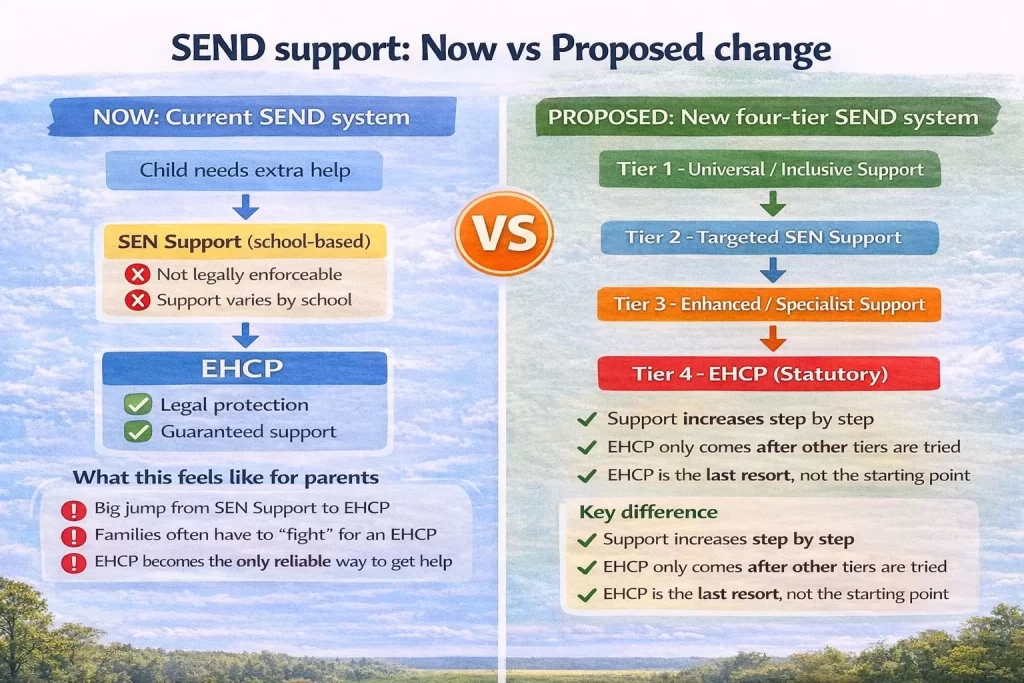
Instead of the current system (SEN Support or an EHCP), children would be placed into one of four support levels, depending on their needs.
Support would increase step by step
Children could move up or down a tier as their needs change
An EHCP would only be considered after the highest tier has been tried
The government has not yet confirmed the final names or exact rules for each tier, but these details are expected to be published in the White Paper.
🔹 EHCPs as a last resort
Under the proposals:
EHCPs would still exist
They would remain legally binding
But they would be used only when all other support levels have failed
This means EHCPs would no longer be the main route to getting help, but the final and most serious level of support.
What the four tiers are expected to look like (indicative)
⚠️ Final names and criteria have not yet been published, but reporting and consultation documents consistently suggest this structure:
🟢 Tier 1 – Universal / Inclusive Support
High-quality teaching
Reasonable adjustments
Inclusive classroom strategies
➡️ For mild or emerging needs
🔵 Tier 2 – Targeted SEN Support
Structured interventions
Time-limited specialist input
Clear outcomes and review cycles
➡️ Roughly comparable to current SEN Support (but intended to be stronger and more consistent)
🟠 Tier 3 – Enhanced / Specialist Support
Regular specialist involvement (e.g. SALT, EP)
Higher funding
Formal support plans (but still non-statutory)
➡️ This is the new layer that does not currently exist
🔴 Tier 4 – Statutory Support (EHCP)
Only when needs cannot be met at Tiers 1–3
Legal protections remain
Expected to apply to fewer children than now
What we don’t know yet
At the moment, it’s still unclear:
Exactly what support each tier will include
How funding will work at each level
Whether lower tiers will be legally enforceable
How parents can challenge decisions or push for more help
These details are expected in the Schools White Paper, possibly in early 2026, with changes likely to be introduced gradually from 2029–30.
Why this matters for parents
This would be a big change from the current system set out in the Children and Families Act 2014, which has just two main routes:
SEN Support in school
A statutory EHCP
The new approach is designed to give earlier and more structured support, but many parents are concerned that:
EHCPs may become harder to access
Most support may not be legally protected
Families may have fewer rights to challenge decisions
How this system affects families in practice will depend entirely on how strong, funded and enforceable the lower tiers are.
1️⃣ Overall structure
| Now (current system) | Proposed change |
|---|---|
| 2 main routes: SEN Support or EHCP | 4 levels of support, with EHCP at the top |
| Big jump from SEN Support to EHCP | Gradual step-by-step support |
| EHCP often needed to secure help | EHCP becomes last resort only |
2️⃣ How support starts
Now
School identifies need
Child is placed on SEN Support
Support depends heavily on school resources
No guaranteed level of help
Proposed
Child is placed into Tier 1, 2, or 3 depending on need
Support increases gradually
More structure and clearer stages
✔ Potential benefit: earlier support
⚠️ Risk: still no legal guarantee at lower levels
3️⃣ Getting an EHCP
| Now | Proposed |
|---|---|
| Parents can request an EHCP early | EHCP considered only after tiers are tried |
| EHCP often used to force support | EHCP reserved for most complex needs |
| Clear legal process | Longer journey before legal protection |
📌 For parents, this likely means more evidence and more waiting.
4️⃣ Legal rights and protection
| Now | Proposed |
|---|---|
| SEN Support = not legally enforceable | Tiers 1–3 = likely not enforceable |
| EHCP = legally binding | EHCP still legally binding |
| Tribunal rights tied to EHCP | Fewer appeal rights before EHCP |
⚠️ Key concern: parents may have less power to challenge decisions at lower levels.
5️⃣ Consistency between areas
Now
Big postcode lottery
Support varies by school and local authority
Proposed
Government says tiers will improve consistency
Parents worry thresholds will vary locally
📌 Consistency depends on national rules and funding, which are not yet confirmed.
6️⃣ Information sharing
| Now | Proposed |
|---|---|
| Parents repeat child’s story often | Digital support passport |
| Transitions are difficult | Record follows child |
| Information can be lost | Better continuity planned |
✔ This is widely seen as a positive change.
7️⃣ What this means emotionally for parents
Now
Parents often push for EHCPs to secure help
High stress and “fight” culture
Proposed
Less immediate pressure to apply for EHCP
More meetings and reviews
Risk of being stuck in a tier without progress
🧠 The system may feel calmer for some families, but more frustrating for others.
Summary: the big difference
✔ Possible improvements
Earlier support
Clearer stages
Better information sharing
Less crisis-driven EHCP applications
⚠️ Main risks
EHCPs harder to access
Most support not legally protected
Fewer appeal rights for parents
Increased gatekeeping
Bottom line for parents
Now: EHCPs are often the only reliable way to get help
Proposed: Support starts earlier, but legal protection comes later
Whether this change helps or harms families will depend on:
Funding
Enforceability
Clear escalation rules
Parents’ right to challenge decisions
What parents may need to do differently under the new SEND system
1️⃣ Track your child’s tier — not just their needs
Now
Parents often focus on whether their child has an EHCP or not.
Under the new system
Parents will need to know:
Which tier your child is in
Why they are in that tier
What would trigger a move to the next tier
👉 Ask directly:
“What tier is my child currently in, and what evidence supports that decision?”
2️⃣ Push for written plans at every stage
Lower tiers are likely to be non-statutory, which means paperwork matters more than ever.
Parents should:
Ask for written support plans
Check support is specific, not vague
Confirm who delivers support and how often
Avoid phrases like:
“As needed”
“When available”
“Access to strategies”
Replace with:
Minutes per week
Named staff
Review dates
3️⃣ Insist on time limits and review points
Key risk under the new system
Children could be left in a tier for too long without progress.
Parents should say:
“We are happy to try this tier, but we expect a review in 6–12 weeks with a clear decision on escalation if progress is limited.”
📌 No review date = no accountability.
4️⃣ Gather evidence earlier and continuously
Under a tiered system, evidence of unmet need becomes crucial.
Parents should keep:
Reports (SALT, EP, CAMHS, paediatrician)
Emails from school
Behaviour logs
Records of exclusions, anxiety, non-attendance, or distress
This helps show that:
Support has been tried
It has not been enough
Escalation is justified
5️⃣ Protect the EHCP route — even while using tiers
Even if schools say:
“We need to work through the tiers first”
Parents can still:
Request an EHCP needs assessment
Do this in parallel, not at the end
You can say:
“We are engaging with the tiered support, but we are also requesting an EHCP assessment as needs may exceed what the tiers can provide.”
📌 Tiers should not be used to block statutory rights.
6️⃣ Be more alert at reviews (especially annual reviews)
Parents may see:
Pressure to “step down” support
Language like “needs can now be met ordinarily”
Ask directly:
“Is the local authority proposing to reduce, amend, or cease support?”
Force clarity and get responses in writing.
7️⃣ Expect more negotiation — and plan for it
The new system may reduce the number of EHCPs, but increase discussion and negotiation.
Parents may need to:
Be more assertive earlier
Ask clearer questions
Follow up meetings in writing
Escalate concerns sooner
This isn’t about being “difficult” — it’s about protecting your child.
At-a-glance: what changes for parents
| Now | Under new system |
|---|---|
| Push for EHCP early | Monitor and challenge tiers |
| Focus on diagnosis | Focus on unmet need and impact |
| One big legal battle | Ongoing evidence and reviews |
| EHCP = main protection | EHCP = final protection |
Bottom line for parents
Under the new system, parents may need to be:
More organised
More evidence-focused
More persistent at lower levels
Clearer about escalation
Support may start earlier — but legal protection still comes late.