
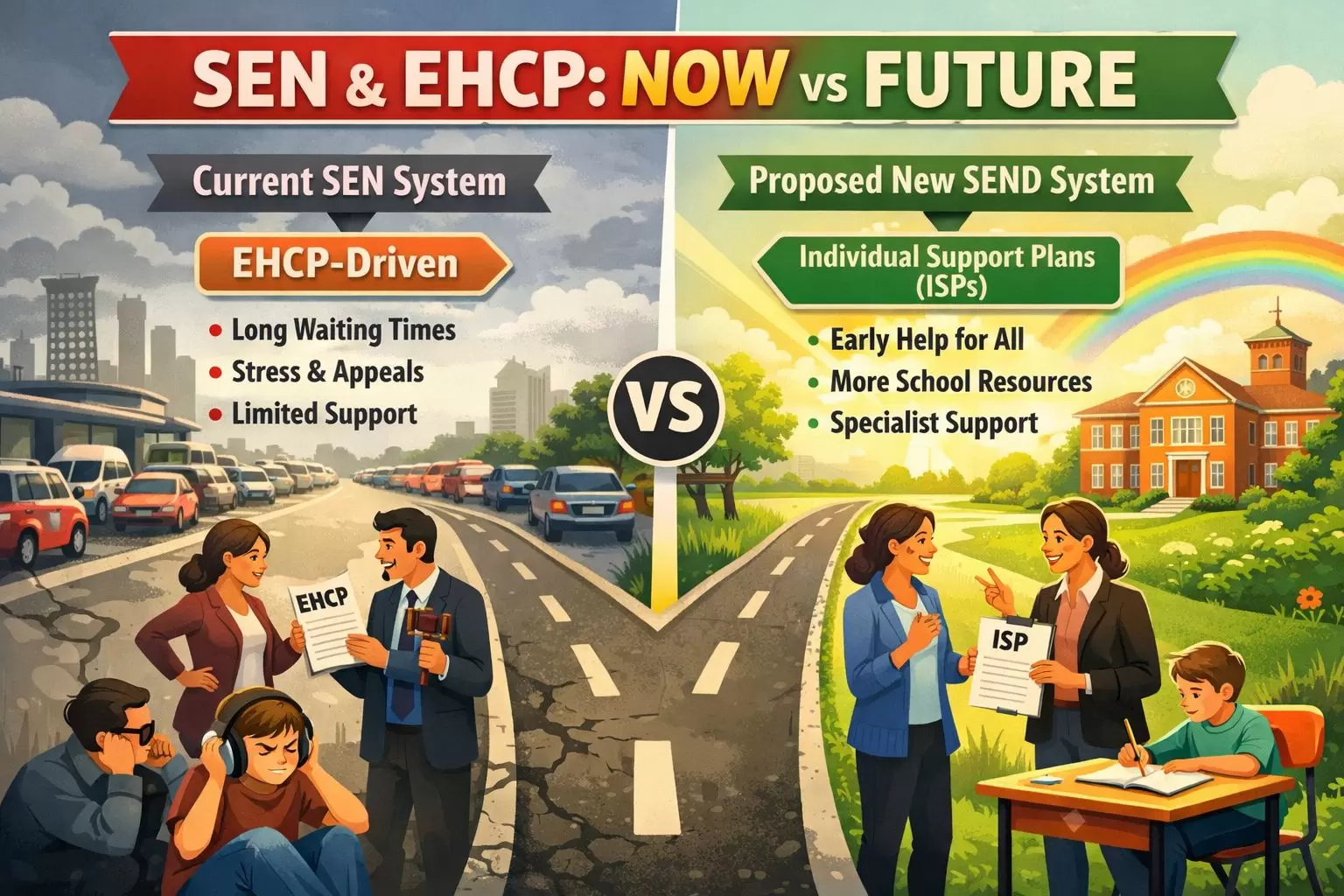
What’s Changing in SEN & EHCP Support – And What Parents Should Know
The government has published proposals to reform the SEN and EHCP system in England, setting out changes to how children with special educational needs may be supported in future. This page explains the key differences between the current SEN and EHCP framework and the proposed SEND reforms, including what may change, what is not changing yet, and what parents need to understand about support, legal rights, and enforceability.
What is this white paper?
This is a government schools white paper published on 23 February 2026 that sets out broad reforms to education, including a major overhaul of the SEND (Special Educational Needs and Disabilities) support system in England.
Note: A white paper means proposals for future legislation. Nothing in it is yet law. There will be a 12-week consultation and then legislation must be passed in Parliament before changes take effect.
Why is reform being proposed?
The government argues that:
The current SEND system (including SEN support and EHCPs) is broken or unsustainable.
Too many families are forced to “fight” for support and funding.
EHCPs have risen massively in number, stressing local authority budgets and systems. This has made support inconsistent and adversarial.
The paper says that a system originally designed for a small number of children with significant needs is now being used as the default route for many types of needs — whether complex or relatively minor.
Core Changes to the SEND Framework
Introduction of Individual Support Plans (ISPs) for all children with SEND
Every child identified with SEND will now have a **legal right to a personalised Individual Support Plan (ISP).
This is a legal requirement on schools — no matter whether a child has an EHCP or not.
ISPs must record a child’s needs and set out the support the school will provide.
Why this matters for parents:
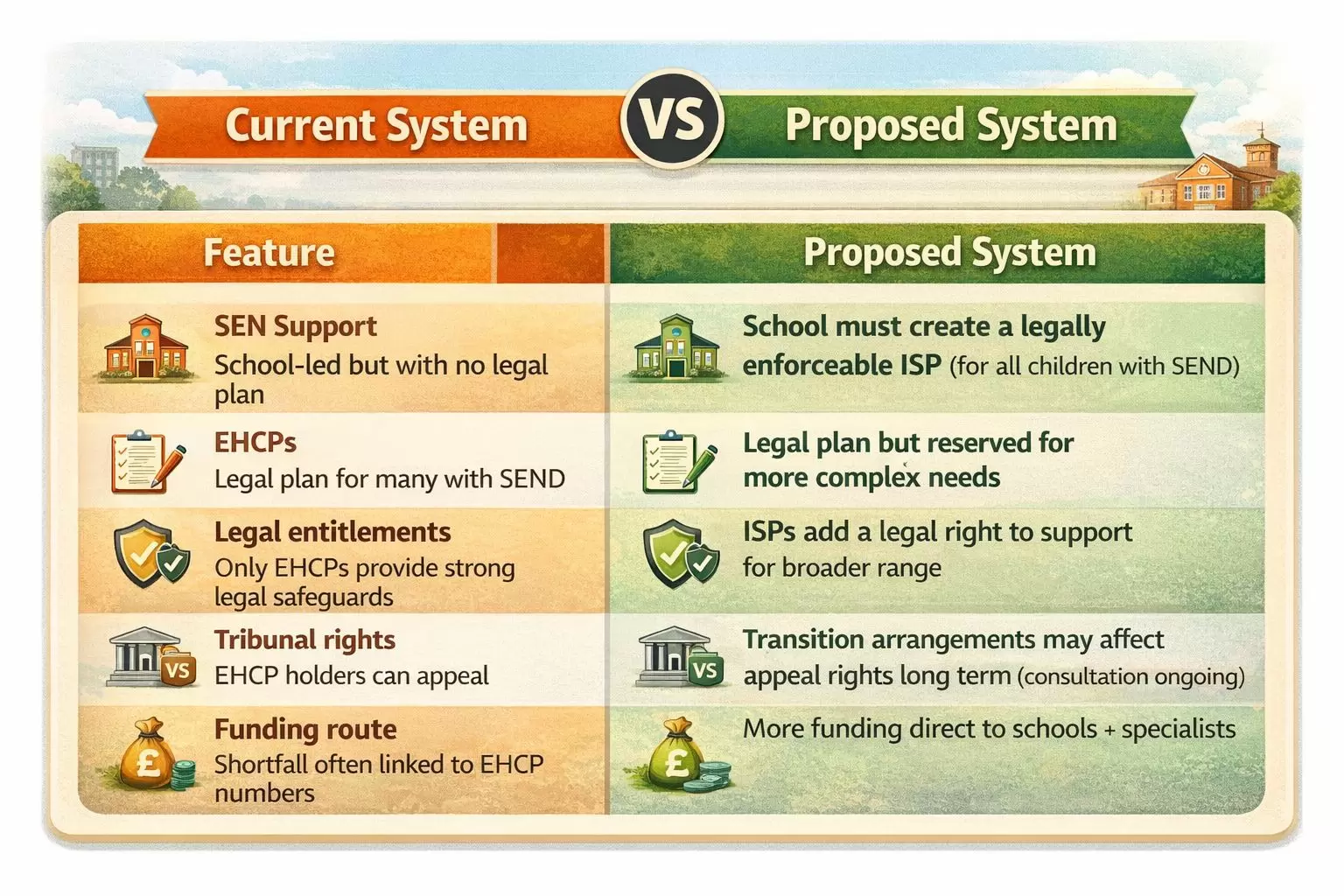
Today, many children with SEND (more than a million) have no legally enforceable support plan at all. Under these proposals, families would have a baseline legal entitlement to a written plan and support, not just those with an EHCP
EHCPs will be retained but more focused
EHCPs still exist — but they will be reserved for children with complex or specialist needs that cannot be met through mainstream provision and ISPs alone.
The idea is to reserve EHCPs for higher-need cases, rather than use them as the default route for a broad range of SEND.
Today: EHCPs are used for many types of needs and deliver a wide range of statutory protections.
Under proposals: Fewer children will have EHCPs — but more children will have legal protection through ISPs.
More support directly in mainstream settings
To back up the ISP system and reduce reliance on EHCPs, the government plans:
A £1.6 billion Inclusive Mainstream Fund for schools over 3 years.
A new £1.8 billion “Experts at Hand” service — giving access to specialists (e.g., speech and language therapists, psychologists) for mainstream schools.
Expansion of specialist support places and inclusion bases.
In other words: More funding will go up front into schools to support children in their everyday setting, rather than schools waiting for families to secure EHCPs firs
How this compares to the existing system
What remains uncertain
This white paper outlines proposals and ambitions, not final changes. Key issues still to be decided include:
Exact legal rights associated with ISPs and whether they will mirror EHCPs on appeal and enforceability.
How existing EHCP holders will transition to the new framework in practice (phasing begins around 2030).
Effectiveness and consistency of mainstream support, especially where specialist staffing is limited.
Practical Summary for Parents
The government is proposing:
✔️ stronger legal rights to support in schools through ISPs for all children with SEND
✔️ reserving the highest level of legal protection (EHCPs) for children with more complex needs
✔️ more funding and specialist professionals available directly to schools
✔️ a shift away from parents needing to fight for an EHCP to access supportBUT:
⚠️ this is not law yet — consultation and parliamentary scrutiny are still to come.
⚠️ exact details of legal protections, appeals, and phasing of change remain to be finalised
What this White Paper Means for Children Who Already Have an EHCP
EHCPs are NOT being abolished
A key reassurance for parents is this:
EHCPs will continue to exist in law.
The government is explicit that EHCPs remain part of the system and will still be used for children with complex, long-term, or specialist needs that cannot reasonably be met through mainstream provision alone.
Important for parents:
This is not a sudden removal of plans or support. There is no proposal to “rip up” existing EHCPs.
However, EHCPs will no longer be the “default route” to support
Under the current system:
EHCPs have become the main way families secure consistent and enforceable support
Many parents feel forced to apply for an EHCP even when needs might be met earlier or differently
Under the proposals:
EHCPs are intended to become more targeted
The system aims to support more children earlier through Individual Support Plans (ISPs), so fewer families feel they must fight for an EHCP just to get help
What this means in practice:
Over time, fewer new EHCPs are likely to be issued, because schools will have a legal duty to support children through ISPs before needs escalate.
What happens to children who already have an EHCP?
Short term (next few years)
Nothing changes immediately
Existing EHCPs continue:
Annual reviews
Legal protections
Tribunal rights
Named provision and placement
Local authorities cannot remove an EHCP simply because the system is changing
Medium to long term (phased change, likely late 2020s)
The government signals that some children may eventually move from EHCPs to ISPs
This would only happen where:
Needs are considered no longer complex
Support can be reliably delivered through mainstream provision
⚠️ Crucially:
The white paper does not yet define:
Clear thresholds for who must keep an EHCP
How parental disagreement would be handled
Whether ISP protections will match EHCP enforceability
These details are expected to be part of future legislation and consultation.
Legal protections: what parents are worried about (and why)
Today, EHCPs provide:
A legally binding document
Specific, quantified provision
Strong appeal rights to tribunal
Enforceability if provision is not delivered
Under the proposals:
ISPs will be legally required, but:
The strength of enforcement is not yet fully defined
It is unclear whether tribunal rights will be identical
This is the biggest concern raised by parent groups and charities.
➡️ Parents of children with EHCPs should understand:
The government says ISPs will strengthen rights overall
But until legislation is published, EHCPs remain the strongest legal protection
Funding changes and what that could mean for EHCP families
The government argues that:
Too much funding currently flows only once an EHCP is issued
This creates delays and conflict
Proposed changes:
More funding directly into mainstream schools
Specialist professionals available without an EHCP
Less reliance on tribunals to unlock support
Potential upside for EHCP families:
Better day-to-day support in schools
Less pressure on EHCPs to “carry everything”
Risk to watch:
If mainstream provision does not improve enough, families may fear pressure to step down from EHCPs without equivalent safeguards
What parents with EHCPs should do now
Right now
No action needed
Existing EHCP rights remain fully in place
Continue annual reviews and advocacy as usual
Over the next 1–3 years
Parents should:
Stay informed about consultation outcomes
Ask schools and local authorities how they are preparing for ISPs
Keep evidence of:
Needs
Outcomes
What support is essential vs optional
Key principle for parents to remember
Any change away from an EHCP must still meet the child’s needs.
A change in paperwork does not justify a reduction in support.
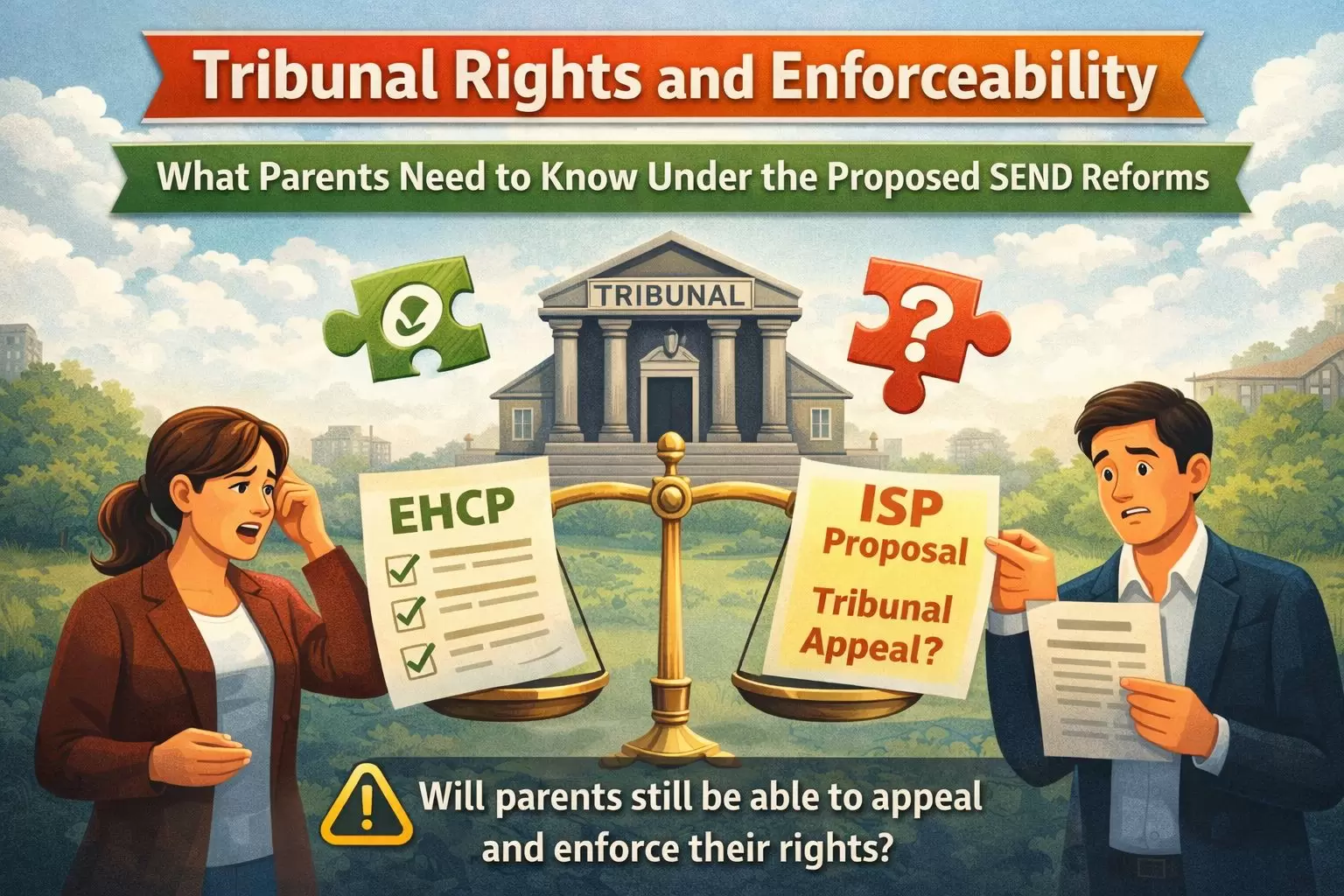
What tribunal rights parents have now (EHCP system)
Under the current SEND framework, an Education, Health and Care Plan (EHCP) gives families strong, enforceable legal rights.
Parents can appeal to the SEND Tribunal if they disagree with:
A refusal to assess for an EHCP
A refusal to issue an EHCP
The description of needs in Section B
The provision specified in Section F
The school or placement named in Section I
A decision to amend or cease an EHCP
Why EHCPs are powerful
The EHCP is legally binding
Provision in Section F must be delivered
Vague wording is unlawful (e.g. “access to” or “opportunities for”)
If provision is not delivered, parents can:
Use complaints
Use judicial review
Return to tribunal
➡️ In short:
An EHCP gives parents a clear legal lever when support is missing or inadequate.
What SEN Support currently lacks
Children on SEN Support (without an EHCP):
Have no statutory plan
Have no direct right of appeal
Rely on:
School discretion
Local authority oversight
Informal complaints processes
This is why many parents feel forced to pursue EHCPs — not because needs are extreme, but because it is the only enforceable route.
What the white paper proposes to change
The white paper introduces Individual Support Plans (ISPs), which will:
Be legally required for all children with SEND
Replace the current informal SEN Support arrangements
Set out needs and support in writing
The government describes this as an expansion of rights, because many more children will have a written plan than under the current system.
However — and this is critical — the white paper does not yet fully define the legal enforceability of ISPs.
The key unresolved question: will ISP decisions be appealable?
What is NOT yet confirmed
The white paper does not yet confirm whether parents will be able to appeal to tribunal over:
The contents of an ISP
The adequacy of provision in an ISP
A decision to move a child from an EHCP to an ISP
Failures to deliver ISP support
This is not a small detail — it is the central safeguard issue.
Why this matters
If ISPs:
Cannot be appealed, or
Can only be challenged through weaker complaints routes
Then parents may lose the strongest protection they currently rely on, even if support is promised “on paper”.
Government position vs parent concerns
Government position
The government argues that:
ISPs will create earlier, more consistent support
Stronger mainstream provision will reduce conflict
Fewer families will need tribunals if support works properly
Parent and sector concerns
SEND charities and parent groups highlight that:
Rights only matter if they are enforceable
Trusting the system without a legal backstop is risky
Tribunal access often ensures compliance, not conflict
➡️ Many parents are not “litigious” — they use tribunal because nothing else works.
Risk area: moving children from EHCPs to ISPs
One of the most sensitive proposals is the idea that some children may transition from EHCPs to ISPs over time.
What is unclear:
Whether parents can appeal a decision to remove an EHCP
What legal test would be applied
Whether “cost” or “system pressure” could influence decisions
Whether ISP protections will equal EHCP protections
⚠️ Without a right of appeal, parents could face reduced safeguards even if needs remain unchanged.
What enforceability must look like to be equivalent
For ISPs to match EHCP protections, legislation would need to confirm:
✔️ A right to challenge the content of an ISP
✔️ A right to challenge failure to deliver provision
✔️ A right to appeal removal or refusal of an EHCP
✔️ Clear duties on schools and local authorities
✔️ Independent oversight (e.g. tribunal or equivalent)
Until these are written into law, EHCPs remain the gold standard for enforceability.
What parents can do now
“EHCPs currently give families the strongest legal rights because you can appeal and enforce them.
The new plans sound positive, but the law hasn’t yet confirmed whether parents will have the same appeal rights.
Until that’s clear, EHCP protections remain very important.”
Do not give up an EHCP voluntarily
Treat any suggestion of stepping down as a formal decision, not an informal conversation
Ask explicitly:
“What appeal rights will I have?”
“What happens if the provision is not delivered?”
Respond to consultations — this issue is still live
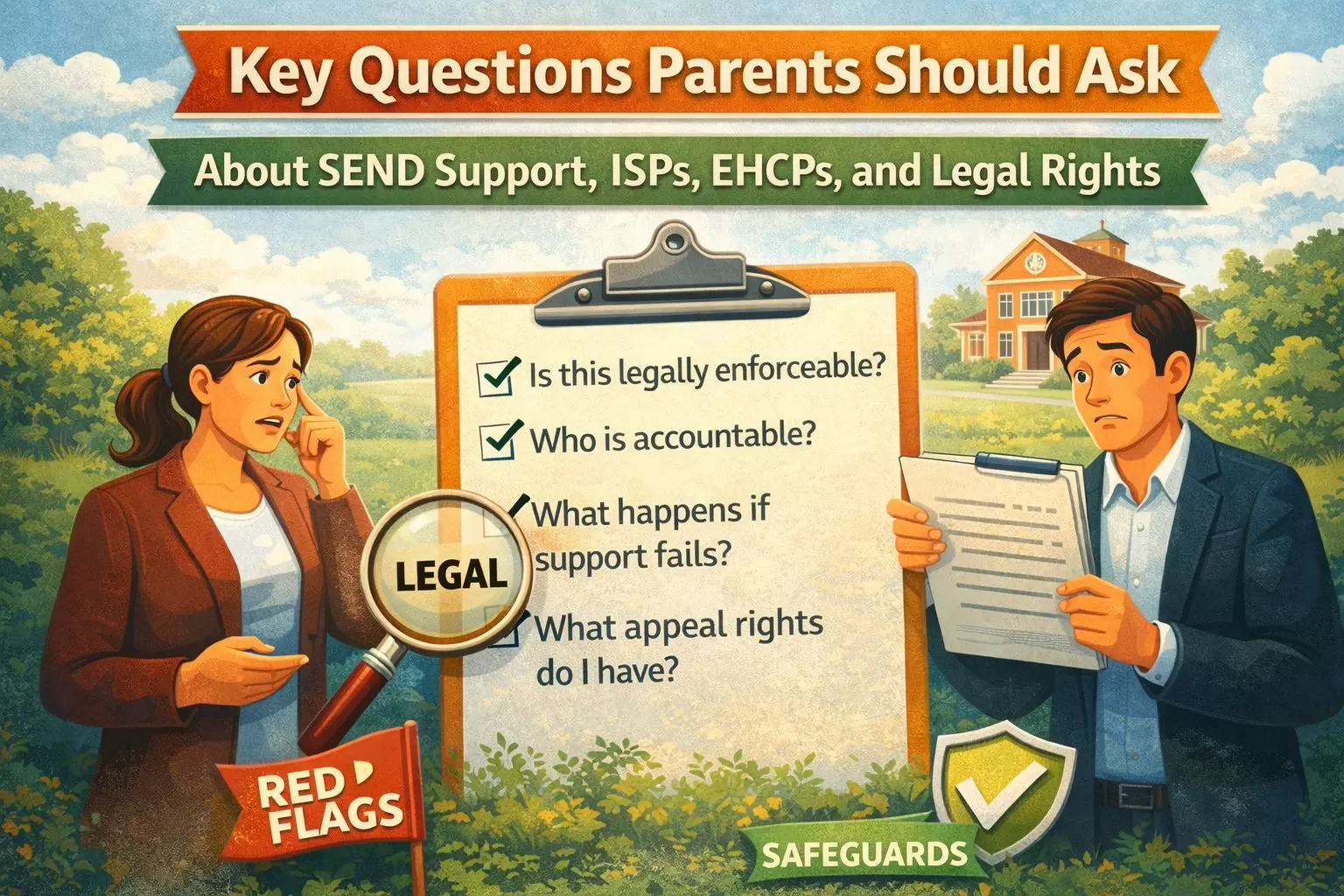
Questions about my child’s current EHCP
Parents of children with an EHCP should ask:
“Is there any proposal to change or remove my child’s EHCP?”
If yes: “On what legal basis?”
“Does my child still meet the legal test for an EHCP?”
Ask for this in writing.
“Can you confirm that my child’s EHCP remains legally binding and enforceable?”
“If provision in Section F is not delivered, what is the formal route for redress?”
“Will any future system changes automatically affect existing EHCPs?”
(Correct answer should currently be no.)
Questions about Individual Support Plans (ISPs)
For any child being discussed under SEN Support or a proposed ISP:
“Is the ISP a legal document?”
Follow up: “What law makes it enforceable?”
“Who is legally responsible for delivering the support in the ISP?”
School? Local authority? Both?
“What happens if the support in the ISP is not delivered?”
Ask for a specific process, not reassurance.
“Can parents challenge the contents of an ISP if they disagree?”
“Is there a right of appeal to the SEND Tribunal for ISP decisions?”
If not, ask: “What independent route replaces it?”
Questions about moving from an EHCP to an ISP
If an EHCP step-down is mentioned or implied:
“What evidence shows my child’s needs are no longer complex?”
“What legal safeguards replace those lost by giving up an EHCP?”
“Can I refuse consent to move from an EHCP to an ISP?”
“Is this a formal decision with appeal rights, or an informal request?”
This distinction matters legally.
“Will support be reduced, changed, or made less specific?”
Ask for side-by-side comparison.
Questions about enforceability and accountability
These questions test whether support is real or aspirational:
“Is the provision specified in hours, frequency, and staffing?”
“Who monitors delivery, and how often?”
“What happens if the school cannot deliver what is written?”
“What independent oversight exists if we disagree?”
“Is there a formal complaints or escalation route beyond the school?”
Questions about funding and resources
Parents should ask openly:
“Is funding already allocated for this support?”
“What happens if funding is not available?”
(Needs should determine provision, not budget.)
“Does this support depend on future funding changes?”
“Is the proposed support sustainable long-term?”
Questions about tribunal and appeal rights
These are critical safeguard questions:
“What decisions can I appeal to the SEND Tribunal right now?”
“Will I retain tribunal rights if my child moves to an ISP?”
“If tribunal rights are reduced, what replaces them?”
“Can I challenge failure to deliver provision, not just the plan itself?”
Questions parents should always ask for in writing
Always ask for these questions in writing.
“Please confirm this decision in writing, including appeal rights.”
“Please provide the legal basis for this decision.”
“Please confirm whether this is a formal or informal decision.”
Red-flag phrases parents should question
Parents should ask follow-ups if they hear:
“We don’t do that anymore”
“Everyone is moving to the new system”
“EHCPs won’t be needed soon”
“This is just how things are going now”
Follow-up questions:
“What legislation supports that statement?”
“I’m happy to discuss new approaches, but I need to understand my child’s legal protections.
Please explain what rights I gain or lose, and what appeal routes exist if this support is not delivered.”