
Last reviewed: March 2026
Written by: School of Diversity SEND Support Team
Topic: Education, Health and Care Plans (EHCP)
This guide is designed to help parents understand the EHCP process in England and is regularly updated to reflect SEND guidance and procedures.
Do I Need an EHCP for My Child?
A child may need an Education, Health and Care Plan (EHCP) if their special educational needs require more support than a school can provide through SEN support alone. EHCPs are designed for children whose needs are complex, long-term, or significantly affect their access to education. Parents or schools can request an EHC needs assessment from the local authority if they believe additional support may be required.
Key Takeaways
A child may need an Education, Health and Care Plan (EHCP) if their needs require more support than can be provided through SEN support alone.
EHCPs are designed for children whose needs are complex, long-term, or significantly affect their access to education.
Parents or schools can request an EHC needs assessment from the local authority if additional support may be required.
Evidence from school, professionals, and parents helps show whether a child’s needs cannot reasonably be met through existing support.
An EHCP ensures the child receives clear, legally enforceable provision to support their education.
Many parents ask this question when their child is struggling at school and existing support does not seem to be working.
If you are wondering whether your child needs an EHCP, you are not alone — and you do not need to have all the answers yet. This guide explains when a child might need an EHCP, how this differs from SEN support, and what to do if school says an EHCP is not necessary.
Does my child need an EHCP?
A child may need an EHCP if their special educational needs cannot be met through SEN support alone.
You might be asking this question if:
Your child is not making progress despite support
School adjustments feel inconsistent or informal
Your child is becoming anxious, distressed, or exhausted
Support depends on goodwill rather than clear planning
You are being told to “wait and see”
Needing an EHCP is about level of need, not labels or diagnoses.
How do I know if my child needs an EHCP?
Parents often notice signs before schools do. You may want to consider an EHCP if:
SEN support has been in place but is not enough
Your child’s needs are complex or long-term
School struggles to meet needs within existing resources
Support is reduced or removed without explanation
Your child masks at school but struggles at home
If support only works some of the time — or only with significant effort — this can indicate the need for a more formal plan.
Signs a child needs an EHCP
There is no single checklist, but common signs include:
Ongoing difficulties accessing learning
Emotional distress linked to school
Increasing behaviour concerns or withdrawal
Fatigue, burnout, or anxiety after school
Lack of progress despite interventions
These signs matter even if your child is academically able.
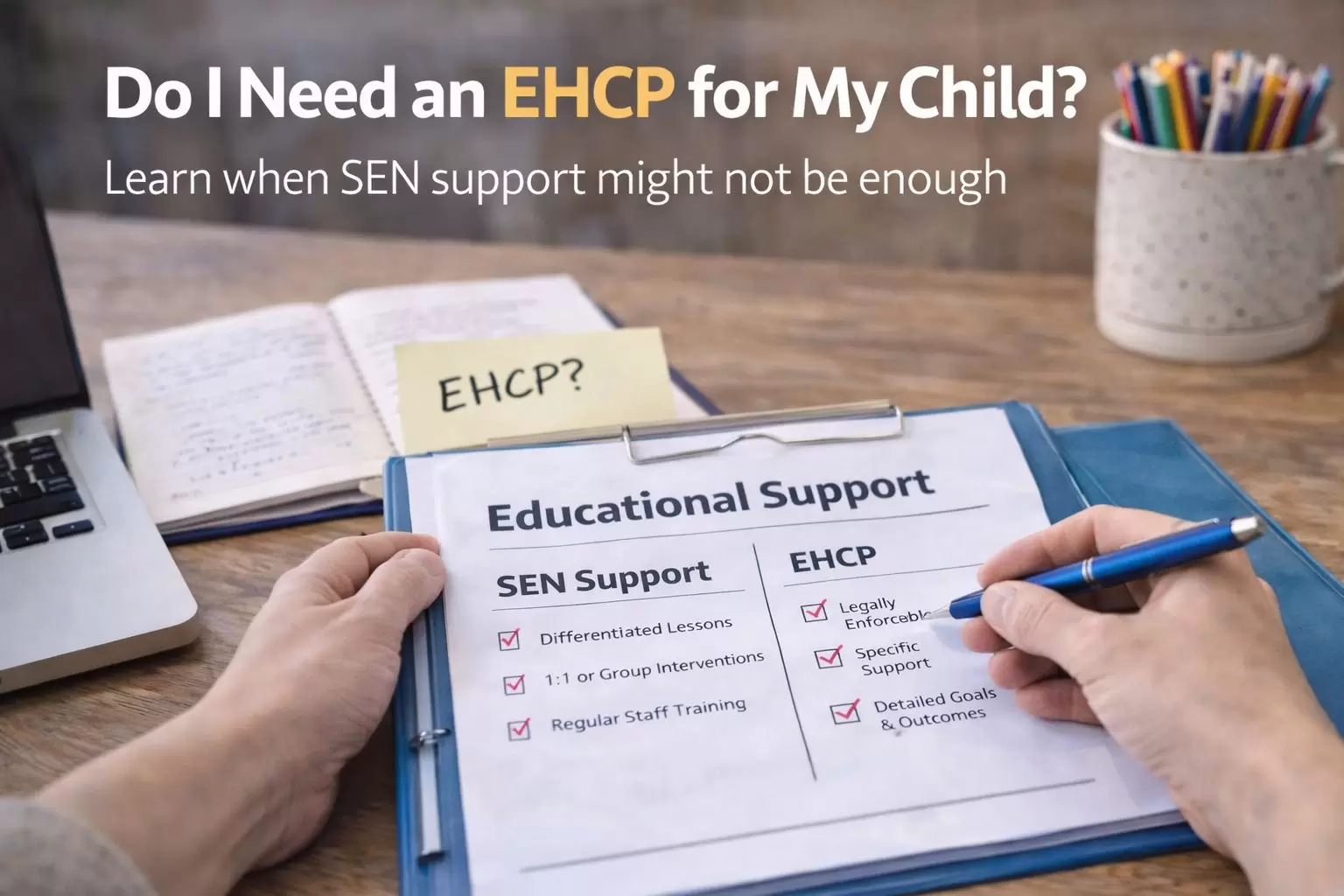
SEN support vs EHCP: what’s the difference?
Understanding the difference between SEN support and EHCP is key to decision-making.
SEN support
Provided by the school
Not legally enforceable
Often flexible and informal
Can be changed or removed
EHCP
Issued by the local authority
Legally binding
Clearly specifies provision
Comes with additional accountability
If SEN support relies on what the school can “manage”, an EHCP sets out what must be provided.
SEN support or EHCP: which is right?
Some children do well with SEN support alone. Others need the structure and protection of an EHCP.
An EHCP may be appropriate if:
SEN support has not led to meaningful progress
Your child’s needs require specialist input
Support cannot be delivered without extra funding
This is not a failure of SEN support — it is about matching support to need.
Can a child have SEN support instead of an EHCP?
Yes. Many children start with SEN support.
However, SEN support should not be used indefinitely if it is not working. The SEND system recognises that some needs require an EHCP.
If school says SEN support is enough, it is reasonable to ask:
How progress is being measured
What will change if progress does not happen
What the next steps would be
School says SEN support is enough — is that true?
Sometimes. But not always.
Schools may say this because:
EHCPs involve more paperwork
Funding pressures exist
Needs are underestimated
Masking hides difficulties
A school’s opinion does not override your right to request an EHC needs assessment.
What level of need qualifies for an EHCP?
There is no fixed threshold or checklist.
Instead, the question is:
Can the child’s needs reasonably be met from the school’s existing resources?
If the answer is no, an EHCP should be considered.
This is often referred to as the graduated approach EHCP threshold — when graduated support is no longer enough.
My child is struggling but school says no EHCP
This is a very common experience.
If this happens, you can:
Request an EHC needs assessment yourself
Ask for evidence showing SEN support is sufficient
Gather your own evidence as a parent
Seek independent advice
You do not need school permission to apply.
Important gaps parents often miss at this stage
An EHCP is not about:
Labelling your child
Proving failure
Diagnoses alone
An EHCP is about:
Securing appropriate support
Reducing uncertainty
Creating accountability
Applying does not mean one will be issued — but it does trigger a formal review of need.
Next steps if you’re unsure
If you are still unsure whether your child needs an EHCP, the next helpful steps are:
Understanding the EHCP assessment process
Learning what evidence is useful
Knowing your rights as a parent
At School of Diversity, we provide clear, parent-focused guidance to help you make informed decisions without pressure or judgement.
Do I Need an EHCP? – Parent FAQs
Do I need an EHCP for my child?
A child may need an EHCP if their needs cannot be met through SEN support alone and they are struggling to access education consistently.
How do I know if my child needs an EHCP?
If SEN support is not working, progress is limited, or support feels inconsistent or informal, an EHCP may be worth considering.
What level of need qualifies for an EHCP?
There is no fixed level or checklist. The key question is whether the school can reasonably meet your child’s needs from its existing resources.
Can a child have SEN support instead of an EHCP?
Lorem ipsum dolor sit amet, consectetur adipiscing elit. Ut elit tellus, luctus nec ullamcorper mattis, pulvinar dapibus leo.
SEN support vs EHCP — what’s the difference?
SEN support is school-led and not legally binding. An EHCP is issued by the local authority and legally requires specified support to be provided.
School says SEN support is enough — is that true?
Sometimes, but not always. Parents have the right to request an EHC needs assessment even if the school disagrees.
My child is struggling but school says no EHCP — what can I do?
You can request an EHC needs assessment yourself, gather your own evidence, and seek independent advice. You do not need school permission.
Does my child need a diagnosis to get an EHCP?
No. A diagnosis is not required. EHCP decisions are based on need, not labels.
Explore more EHCP guidance
Deciding whether your child may need an EHCP can be an important step in understanding how their needs can be supported at school. If you would like a broader overview of the process, you can explore our complete EHCP guide for parents, where all of our EHCP resources are brought together in one place.
If you are considering taking the next step, our guide on how to apply for an EHCP explains how parents can request an EHC needs assessment. You may also want to understand how long an EHCP takes, which outlines the typical timeline from request to final plan. If you are preparing to request an assessment, our guide on what evidence you need for an EHCP explains the types of information that can help support the request.