
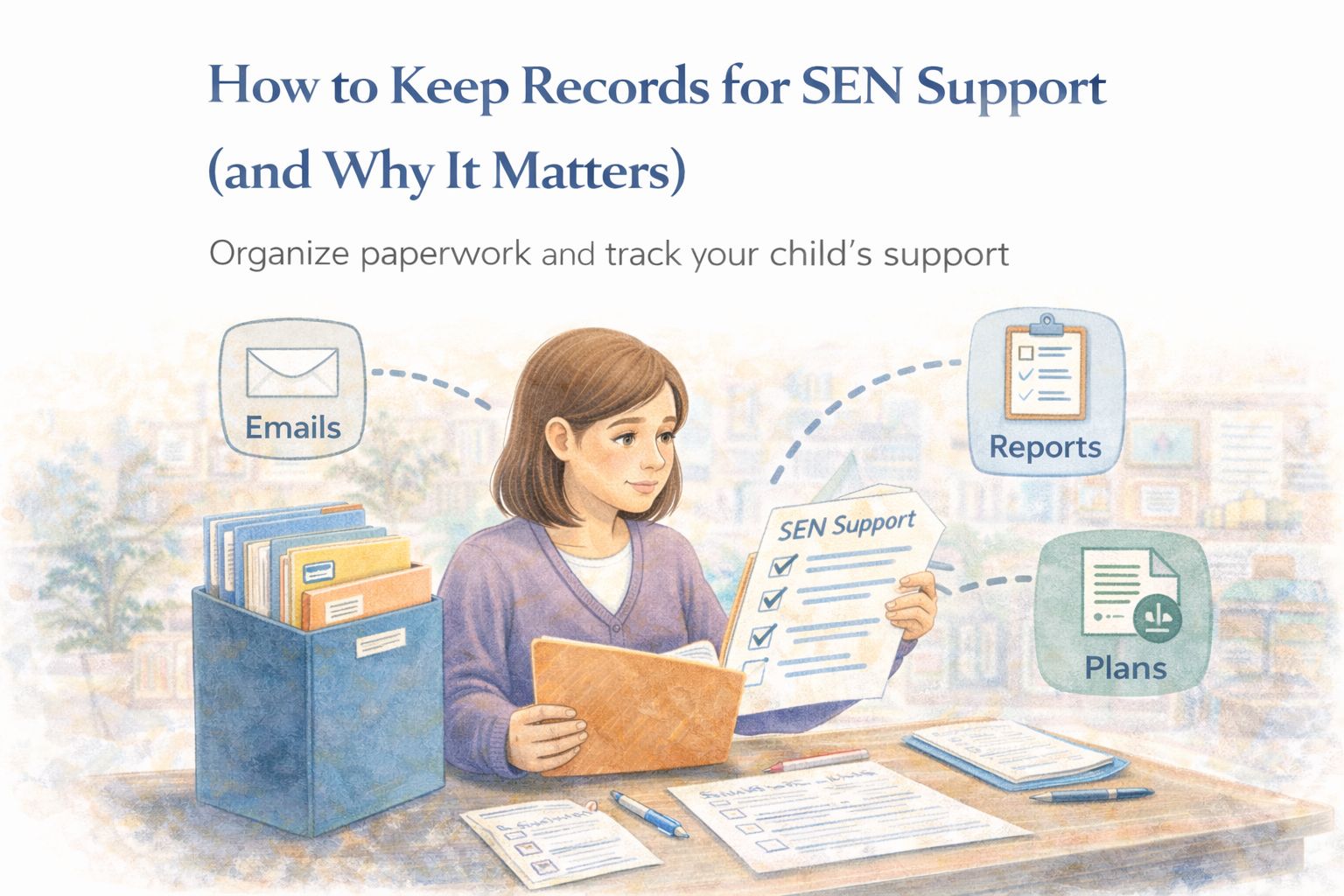
How to Keep Records for SEN Support (and Why It Matters)
When your child receives SEN Support, the amount of paperwork, emails and meetings can quickly build up.
Many parents tell me:
“I wish I had kept everything from the beginning.”
Good record-keeping is one of the most powerful tools you have.
It protects your child, supports conversations with school, and becomes essential if you ever need to request an EHCP.
New to SEN Support? Start with our main resource: SEN Support for Parents.
Why Keeping Records Matters So Much
Clear records help you:
track what has been promised
notice patterns over time
see what is (and isn’t) working
avoid repeating the same conversations
provide evidence if support needs to increase
In difficult moments, written records often speak louder than memory.
Read our article: What Is SEN Support?
What Types of Records Should Parents Keep?
Think of SEN documentation in three categories:
1. Communication
Keep:
emails with teachers and SENCo
meeting invitations
summaries and follow-ups
messages discussing concerns
Always try to confirm verbal conversations with a short email.
2. School Documents
This includes:
support plans / IEPs
behaviour logs
attendance records
reports and academic data
incident notes
exclusions paperwork
These documents show progress and challenges over time.
3. Professional Reports
If your child receives assessments, keep:
educational psychology reports
speech and language therapy reports
occupational therapy reports
CAMHS letters
medical notes
These can be vital when discussing next steps or EHCP assessments.
If you’re unsure whether an EHCP may be needed, read: SEN Support vs EHCP.
How to Organise SEN Records Effectively
Organisation reduces stress.
Option 1: Physical Folder System
Use separate sections labelled:
School communication
Support plans and reviews
Assessments and reports
Meeting notes
Timeline of concerns
Option 2: Digital Folder System
Create folders on your computer or cloud storage.
Save:
PDFs
screenshots
emailed attachments
Name files clearly (e.g., “IEP_Review_July2026”).
Creating a Simple Timeline
A timeline helps everyone see the story clearly.
Include:
key events
dates of meetings
support changes
incidents
exclusions
referrals
A simple list can make a huge difference during discussions.
Recording What Happens After Meetings
After every meeting, capture:
what was agreed
who is responsible
when it will happen
when it will be reviewed
Then send a short email saying:
“Just to confirm my understanding from today’s meeting…”
Written clarity prevents confusion later.
See our guide: Questions to Ask in a SEN Support Meeting.
Evidence That Helps if You Request an EHCP
If you ever apply for an EHCP, decision-makers will want to see:
what has already been tried
how your child responded
ongoing difficulty despite support
professional involvement
Your records help demonstrate need — calmly and clearly.
Learn more about requesting support on our EHCP Advocacy & Support page.
Common Mistakes Parents Make (And How to Avoid Them)
- relying on memory
- deleting emails to “declutter”
- not saving drafts of letters
- not asking for written meeting notes
Instead:
- keep everything
- date everything
- back up digital files
- follow meetings with emails
FAQ — Keeping SEN Records
Do I really need to keep everything?
Yes. You can always discard later — but once lost, information is hard to retrieve.
Should I share my records with the school?
Share selectively when helpful. Keep originals for yourself.
How long should I keep SEN records?
Keep them for the duration of schooling, ideally until age 25 if your child has ongoing needs.
Will schools mind that I keep such detailed records?
No. Good schools appreciate clarity and partnership.
Conclusion
Keeping records is not about being confrontational.
It is about:
clarity
accuracy
protecting your child
supporting fair decision-making
And it often reduces stress — because everything is in one place.