
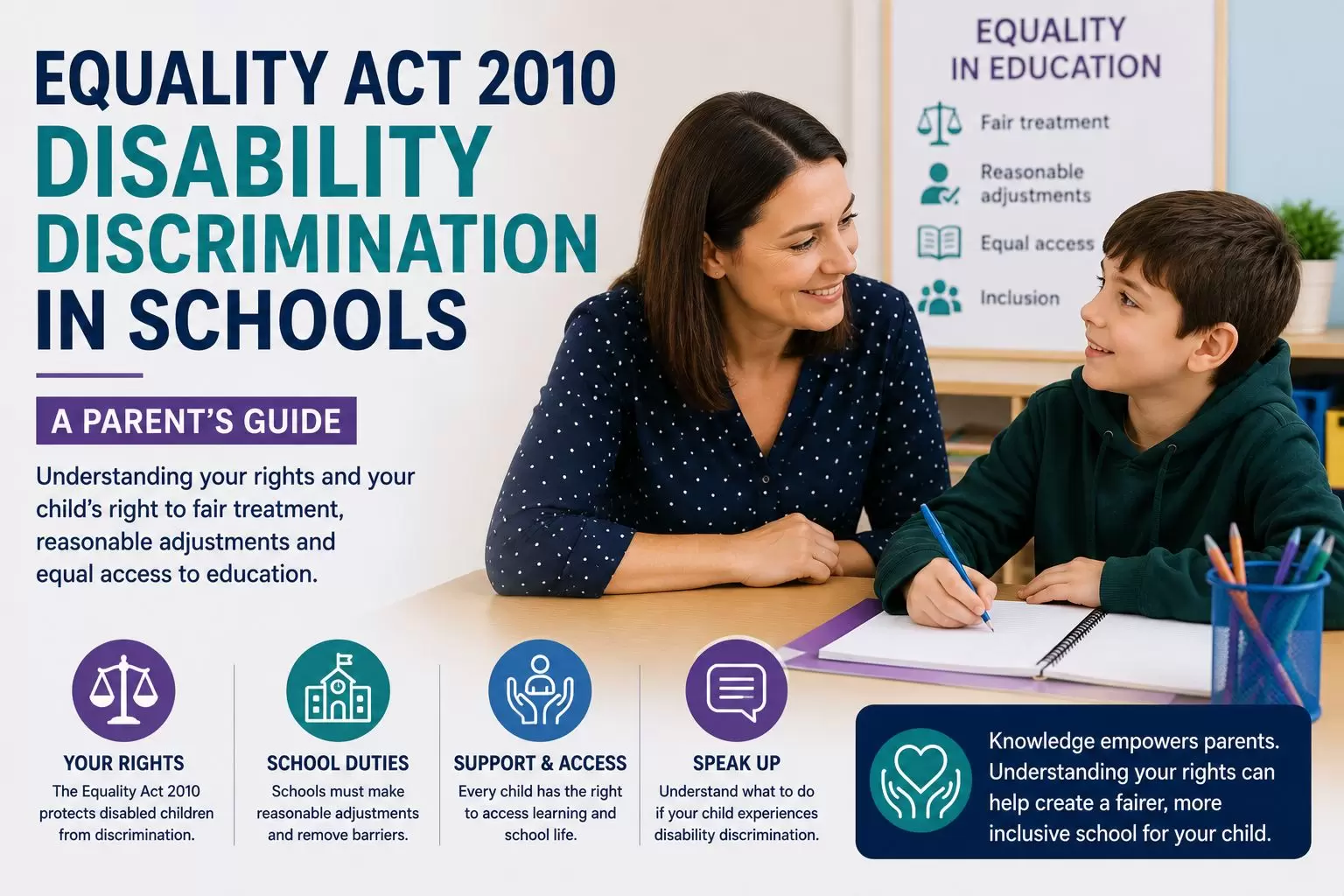
Equality Act 2010 Disability Discrimination in Schools: A Parent's Guide
If your child has a disability or a long-term health condition, you may wonder what legal protection they have at school. The Equality Act 2010 is the key law that makes it unlawful for schools to discriminate against a pupil because of their disability. This guide explains what that means for your family, what types of discrimination are banned, and what schools must do to help.
What the Equality Act 2010 Means for Your Child at School
The Equality Act 2010 applies to all maintained schools and academies in England. It protects pupils from being treated unfairly because of a disability. Under the Act, disability is defined as a physical or mental impairment that has a substantial and long-term adverse effect on a person’s ability to carry out normal day-to-day activities. This covers a wide range of conditions, including autism, ADHD, dyslexia, physical disabilities, and long-term medical conditions.
Schools have a legal duty not to discriminate against disabled pupils. They must also make “reasonable adjustments” to ensure that disabled pupils are not placed at a substantial disadvantage compared to their non-disabled peers. This duty is anticipatory, meaning schools must think ahead about what adjustments might be needed, rather than waiting for a problem to arise.
The Types of Disability Discrimination Schools Must Avoid
There are several forms of unlawful disability discrimination that schools must be careful to avoid. Understanding these can help you recognise if your child’s rights are being infringed.
Direct discrimination occurs when a disabled pupil is treated less favourably explicitly because of their disability. For example, refusing to admit a pupil to a school solely because they have a wheelchair.
Indirect discrimination happens when a school policy or practice applies to all pupils but disproportionately disadvantages disabled pupils. An example would be providing application forms only in a printed format that is inaccessible to a visually impaired pupil.
Discrimination arising from disability means treating a disabled pupil unfavourably because of something connected to their disability (such as needing extra time to complete tasks), when that treatment cannot be justified.
Harassment includes unwanted behaviour related to a pupil’s disability that violates their dignity or creates an intimidating, hostile, or humiliating environment.
Victimisation occurs when a pupil is treated badly because they have made a complaint about discrimination or supported someone else’s complaint.
Importantly, schools may treat disabled pupils more favourably than non-disabled pupils if doing so helps achieve equality. This is permitted under the Act.
Understanding Reasonable Adjustments for Disabled Pupils
The duty to make reasonable adjustments is one of the most powerful protections for disabled children in schools. It requires schools to change their practices, policies, and physical environment (where reasonable) to remove barriers. However, the duty to make reasonable adjustments does not cover physical alterations to buildings. Instead, those longer-term improvements fall under the separate accessibility planning duty.
Examples of reasonable adjustments include:
Providing auxiliary aids and services, such as specialist equipment, personal assistance, or assistive technology.
Changing school rules or routines, for instance allowing a child with anxiety to leave a noisy classroom early.
Offering extra time or different formats for exams and assessments.
Because the duty is anticipatory, schools are expected to consider in advance what adjustments disabled pupils are likely to need. This means you should not have to repeatedly ask for the same support.
How Reasonable Adjustments Differ from Accessibility Planning
It can be confusing to know what schools are required to do immediately versus over time. The table below summarises the key differences between the two duties.
Aspect | Reasonable Adjustments Duty | Accessibility Planning Duty |
|---|---|---|
What it covers | Changes to practices, policies, and provision of auxiliary aids/services to remove disadvantages for disabled pupils | Long-term improvements to physical access, curriculum access, and access to information |
Physical building alterations | Not required under this duty | Required as part of the school’s accessibility plan (e.g., installing ramps, widening doorways) |
Nature of duty | Anticipatory and ongoing | Ongoing with planned improvements set out in a three-year accessibility plan |
Who is responsible | The individual school (maintained or academy) | The school, working with the local authority’s Accessibility Strategy |
The Public Sector Equality Duty: What Schools Must Do
Beyond the specific duties around disability, schools also have a broader Public Sector Equality Duty. This requires them to:
Eliminate unlawful discrimination, harassment, and victimisation.
Advance equality of opportunity between disabled and non-disabled people.
Foster good relations between different groups.
To show they are meeting this duty, schools must publish information about how they comply and set one or more equality objectives. These objectives are usually reviewed every four years. As a parent, you can ask to see your child’s school equality policy and objectives to check they are taking their responsibilities seriously.
What to Do If You Believe Discrimination Has Occurred
If you think your child has been discriminated against at school because of their disability, start by raising your concerns with the school directly. Many issues can be resolved through a conversation with the headteacher or the school’s SENCO (Special Educational Needs Coordinator). If the problem continues, you might need to make a formal complaint. Citizens Advice can offer guidance on the steps to take, and you may also want to seek legal advice from a solicitor who specialises in education law. The process for bringing a claim to a tribunal is specific, and it’s wise to check the latest guidance from the government or a qualified adviser.
Frequently Asked Questions
Does my child need an Education, Health and Care (EHC) plan to get reasonable adjustments?
No. The duty to make reasonable adjustments applies to all disabled pupils, whether or not they have an EHC plan. If your child meets the definition of disability under the Equality Act 2010, the school must consider and make adjustments regardless of any formal plan.
Can a school ever treat a disabled pupil less favourably?
In very limited circumstances, yes. A school may treat a disabled pupil less favourably if it can show the treatment is a proportionate means of achieving a legitimate aim. However, this is rare, and schools are expected to avoid discrimination wherever possible.
What counts as a ‘substantial disadvantage’ for reasonable adjustments?
The term is not precisely defined in law, but ‘substantial’ means more than minor or trivial. The school must assess whether the disadvantage is material and significant compared to non-disabled pupils. This will depend on the individual child’s situation and the impact of the disability on their school experience.
Are independent schools covered by the same rules?
The Equality Act 2010 does apply to independent schools in England, but the obligations may differ slightly from those on maintained schools and academies. It is best to check the specific provisions with the government’s official guidance or seek legal advice if your child attends an independent school.
Knowing your child’s rights under the Equality Act 2010 is the first step toward making sure they receive fair treatment at school. The law is on your side, and schools have clear duties to prevent discrimination and make reasonable adjustments. If you ever feel unsure, reach out to support organisations or a specialist education lawyer to help you navigate the system and advocate effectively for your child.
Final Thoughts
Understanding the Equality Act 2010 can help parents recognise when a child may need reasonable adjustments, better access to learning or stronger protection from disability discrimination in school. Where a child’s needs are affecting their education, it may also be useful to consider how this links with SEN Support and whether additional provision is needed through an EHCP. You may find it helpful to read our guides on what support an EHCP can provide, do I need an EHCP? and what level of need qualifies for an EHCP. If school says your child does not need more support, our guide on school says my child doesn’t need an EHCP can help you understand your next steps.
One Response