
What Support Does an EHCP Provide?
Last reviewed: March 2026
Written by: School of Diversity SEND Support Team
Topic: Education, Health and Care Plans (EHCP)
This guide explains what support an Education, Health and Care Plan (EHCP) can provide, including educational support, therapies and specialist provision for children with SEND.
An EHCP provides tailored support to help a child access education. This may include additional teaching support, specialist interventions, therapies and adjustments to the learning environment. The support is legally enforceable and must be delivered by the school or local authority.
Key Takeaways
An EHCP provides additional support beyond SEN support.
Support is tailored to the child’s individual needs.
Provision is written in Section F of the EHCP.
Support may include education, therapy and specialist provision.
The support is legally enforceable.
An Education, Health and Care Plan (EHCP) is designed to ensure that children with additional needs receive the support required to access education. Parents often ask what support an EHCP actually provides and how it differs from the support already available in schools.
Understanding the types of support included in an EHCP can help parents ensure the plan reflects their child’s needs.
Types of Support in an EHCP
Direct answer:
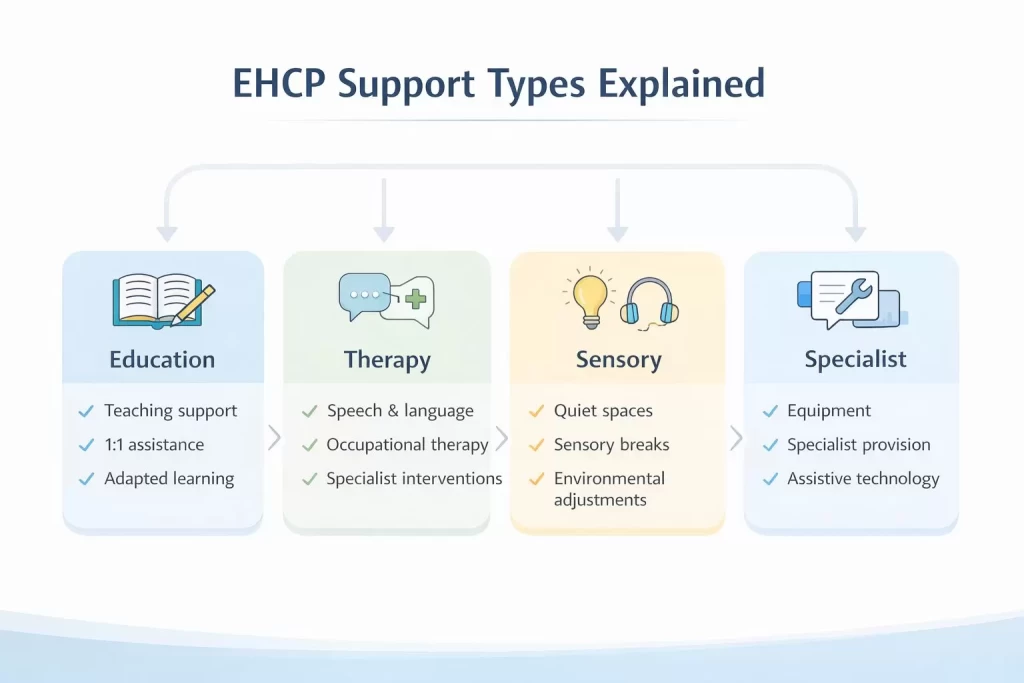
An EHCP can include a range of support tailored to a child’s needs.
This may include:
educational support
communication support
therapy services
sensory support
specialist provision
Support should be clearly described and linked to the child’s needs.
Educational Support
Direct answer:
Educational support helps children access learning in school.
This may include:
additional adult support in the classroom
small group or one-to-one teaching
adapted teaching methods
structured learning approaches
support with literacy or numeracy
The level of support depends on the child’s needs.
Therapy and Specialist Support
Direct answer:
Some EHCPs include therapy support to meet a child’s needs.
This may include:
speech and language therapy
occupational therapy
physiotherapy
specialist interventions
These services help support development and learning.
Communication Support
Children who experience communication differences may receive support such as:
visual communication tools
structured communication approaches
support with understanding instructions
specialist teaching strategies
Clear communication support helps children engage in learning.
Sensory Support
Direct answer:
Some children require sensory support to help them access the school environment.
This may include:
sensory-friendly environments
movement breaks
adjustments to lighting or noise
access to quiet spaces
Sensory support helps reduce overwhelm and improve focus.
Specialist Provision and Equipment
EHCPs may include specialist provision such as:
assistive technology
specialist equipment
adapted learning materials
specialist teaching resources
These adjustments help children access education more effectively.
Where Is Support Written in an EHCP?
Direct answer:
Support is described in Section F of an EHCP.
Section F should:
clearly describe the support required
specify how often support is delivered
identify who provides the support
Clear wording is important to ensure the support is delivered properly.
How EHCP Support Is Delivered
Schools are responsible for delivering the support described in the EHCP.
This involves:
implementing support strategies
coordinating staff and resources
monitoring progress
working with parents and professionals
The local authority oversees the plan to ensure provision is delivered.
.
What Makes EHCP Support Different From SEN Support?
Direct answer:
EHCP support is more detailed and legally enforceable compared to SEN support.
Key differences include:
EHCP support is written in a legal document
provision must be delivered as specified
support is usually more intensive or specialist
the local authority is responsible for ensuring delivery
Examples of EHCP Support
Support varies depending on individual needs, but examples may include:
daily one-to-one support
weekly therapy sessions
structured communication programmes
specialist teaching approaches
sensory regulation strategies
Each EHCP is tailored to the child.
FAQ
Does an EHCP guarantee support?
Yes. The support written in the plan must be delivered.
Can EHCP support change over time?
Yes. Support can be updated during annual reviews.
Who provides the support in an EHCP?
Schools deliver the support, and the local authority ensures it is provided.
Is therapy always included in an EHCP?
Not always. Therapy is included if it is required to meet the child’s needs.
Explore More EHCP Guidance
If you are exploring EHCP support for your child, you may find these guides helpful:
You can also explore our complete EHCP guide for parents, which explains every stage of the EHCP process.