
Last reviewed: June 2026
Written by: School of Diversity SEND Support Team
Topic: Education, Health and Care Plans (EHCP)
This guide is designed to help parents understand the EHCP process in England and is regularly updated to reflect SEND guidance and procedures.
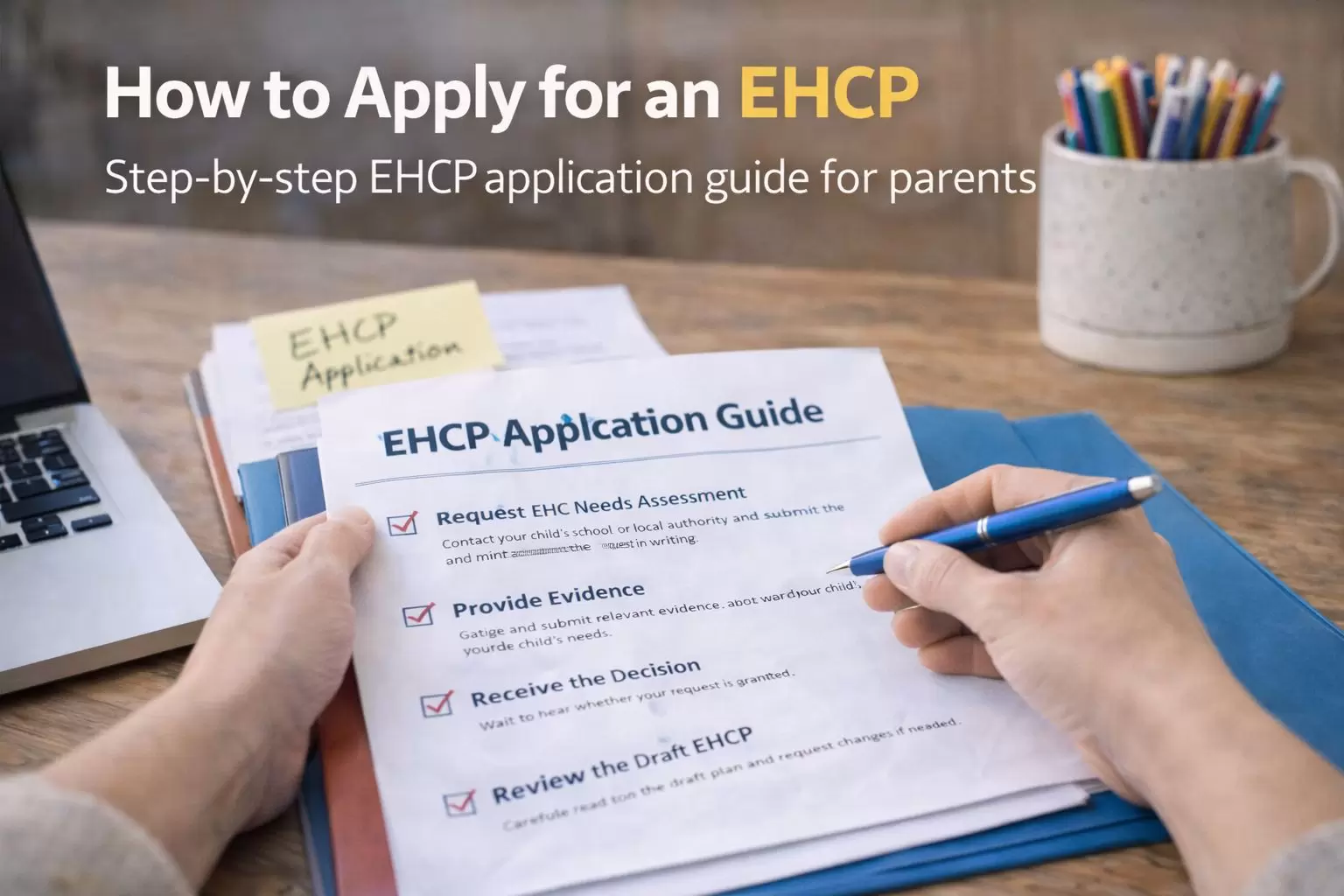
How to Apply for an EHCP for Your Child in England ?
To apply for an EHCP for your child in England, you must write to your local authority and request an Education, Health and Care needs assessment. A parent can make this request directly and does not need the school’s permission. Include your child’s details, their special educational needs, the difficulties they experience in education, the support already tried and any relevant evidence.
If your child is struggling at nursery, school or college and the support currently available is not enough, you may be considering applying for an Education, Health and Care Plan, usually called an EHCP.
The EHCP process can feel complicated, particularly when you are already trying to support a child whose needs are not being fully understood or met. This guide explains how to apply for an EHCP in England, who can make a request, what evidence to include, the legal test your local authority must apply and what happens after your request is submitted.
Key Takeaways
- Parents can request an EHC needs assessment directly from the local authority and do not need the school’s permission.
- Schools, colleges and certain professionals can also ask the local authority to consider an assessment.
- The request should explain the child’s special educational needs, the impact on education, the support already tried and any relevant evidence.
- The local authority must normally decide within six weeks whether to carry out an EHC needs assessment.
- Where an assessment leads to an EHCP, the full process should normally be completed within 20 weeks, subject to limited statutory exceptions.
Important: you are requesting an assessment first
Parents often describe this process as “applying for an EHCP”. However, the formal first step is to request an EHC needs assessment.
The assessment is used to identify your child’s education, health and social care needs and the special educational provision they may require.
Following the assessment, the local authority decides whether it is necessary to issue an EHC plan.
A request for an assessment does not automatically result in an EHCP. However, the local authority must consider your request using the correct legal test.
The legal test for an EHC needs assessment
The legal test
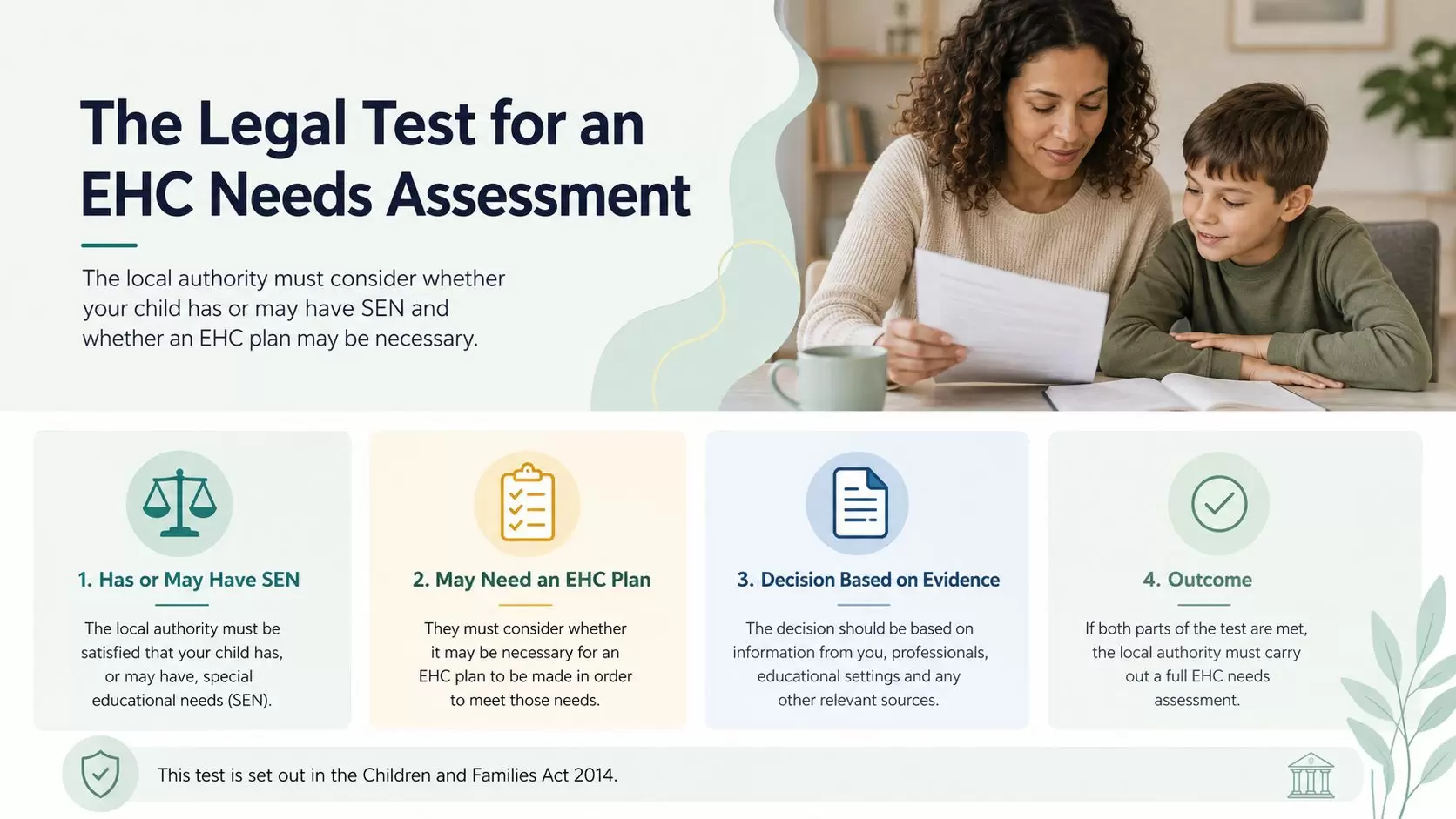
Under section 36 of the Children and Families Act 2014, the local authority must consider whether:
- your child has or may have special educational needs; and
- it may be necessary for special educational provision to be made through an EHC plan.
The law does not require you to prove at the application stage that your child will definitely need an EHCP.
The question is whether your child has or may have special educational needs and whether it may be necessary for provision to be made through an EHC plan.
This is an important distinction. A local authority should not apply a higher threshold by asking you to prove in advance that an EHCP is definitely necessary.
The assessment itself is intended to gather the information needed to understand your child’s needs and determine whether an EHC plan is required.
Who can request an EHC needs assessment?
A request can be made by:
- a parent or carer;
- a young person aged over 16 but under 25;
- a school, nursery or college; or
- another person who believes an assessment may be necessary.
This could include a health professional, foster carer, social worker or other person involved with the child or young person.
When someone other than a parent or young person brings a child to the local authority’s attention, the local authority should consider whether an assessment may be necessary.
Can a parent apply for an EHCP directly?
Yes. A parent can request an EHC needs assessment directly from the local authority.
You do not have to wait for the school to submit the request. You can also make the request where:
- the school does not agree that an assessment is needed;
- the school says your child is making academic progress;
- your child does not yet have a diagnosis;
- your child masks their difficulties at school;
- your child’s needs are more visible at home;
- your child is regularly absent or unable to attend;
- your child is on a reduced timetable;
- your child has been excluded;
- your child is not currently attending a school;
- your child is educated at home; or
- your child is approaching a transition between settings.
It is usually helpful to tell the school that you are making the request, because the local authority is likely to ask the school for information. However, the school’s agreement is not a legal requirement for a parent to submit a request.
Does my child need a diagnosis before I apply?
No. A child does not need a formal diagnosis before a parent can request an EHC needs assessment.
EHCP decisions should be based on your child’s special educational needs and the provision they may require, rather than solely on whether they have received a particular diagnosis.
For example, a child may have significant needs relating to:
- communication and interaction;
- cognition and learning;
- social, emotional and mental health;
- sensory processing;
- physical needs;
- attention and executive functioning;
- emotional regulation;
- anxiety;
- school attendance;
- independence; or
- preparation for adulthood.
Evidence of these needs can come from parents, school records, professionals, assessments, observations and information about your child’s day-to-day functioning.
A diagnosis can be useful evidence, but it is not a prerequisite for requesting an assessment.
Can I apply if my child is doing well academically?
Yes.
Good grades do not necessarily mean that a child’s special educational needs are being adequately met.
A child may be achieving expected or above-expected academic results while also experiencing:
- significant anxiety;
- masking;
- sensory overload;
- emotional exhaustion;
- distress before or after school;
- difficulty attending;
- dependence on adult support;
- social communication difficulties;
- problems with transitions;
- reduced independence;
- demand avoidance;
- difficulty completing work consistently; or
- an inability to access school without substantial support.
The local authority should consider the complete picture of your child’s needs, progress, wellbeing and access to education.
Academic attainment is relevant, but it should not be treated as the only measure of need.
When should I consider requesting an EHC needs assessment?
You may wish to consider making a request where your child:
- is not making expected progress despite additional support;
- requires support beyond what is ordinarily available through SEN Support;
- has complex or overlapping needs;
- needs coordinated support from education, health and social care;
- requires frequent or specialist intervention;
- needs provision that the school cannot reliably provide from its existing resources;
- is experiencing persistent anxiety or emotional distress connected with education;
- is unable to attend school consistently;
- is receiving education on a reduced timetable;
- has experienced repeated suspensions or exclusions;
- needs substantial adult assistance to access learning;
- is approaching a significant transition;
- has needs that are not fully understood;
- is deteriorating despite support being in place; or
- is at risk of disengaging from education.
You do not have to wait until your child has failed completely, reached crisis point or been permanently excluded.
The legal test includes the words “has or may have” and “may be necessary”. This reflects the fact that an assessment may be needed to establish the full extent of a child’s needs and required provision.
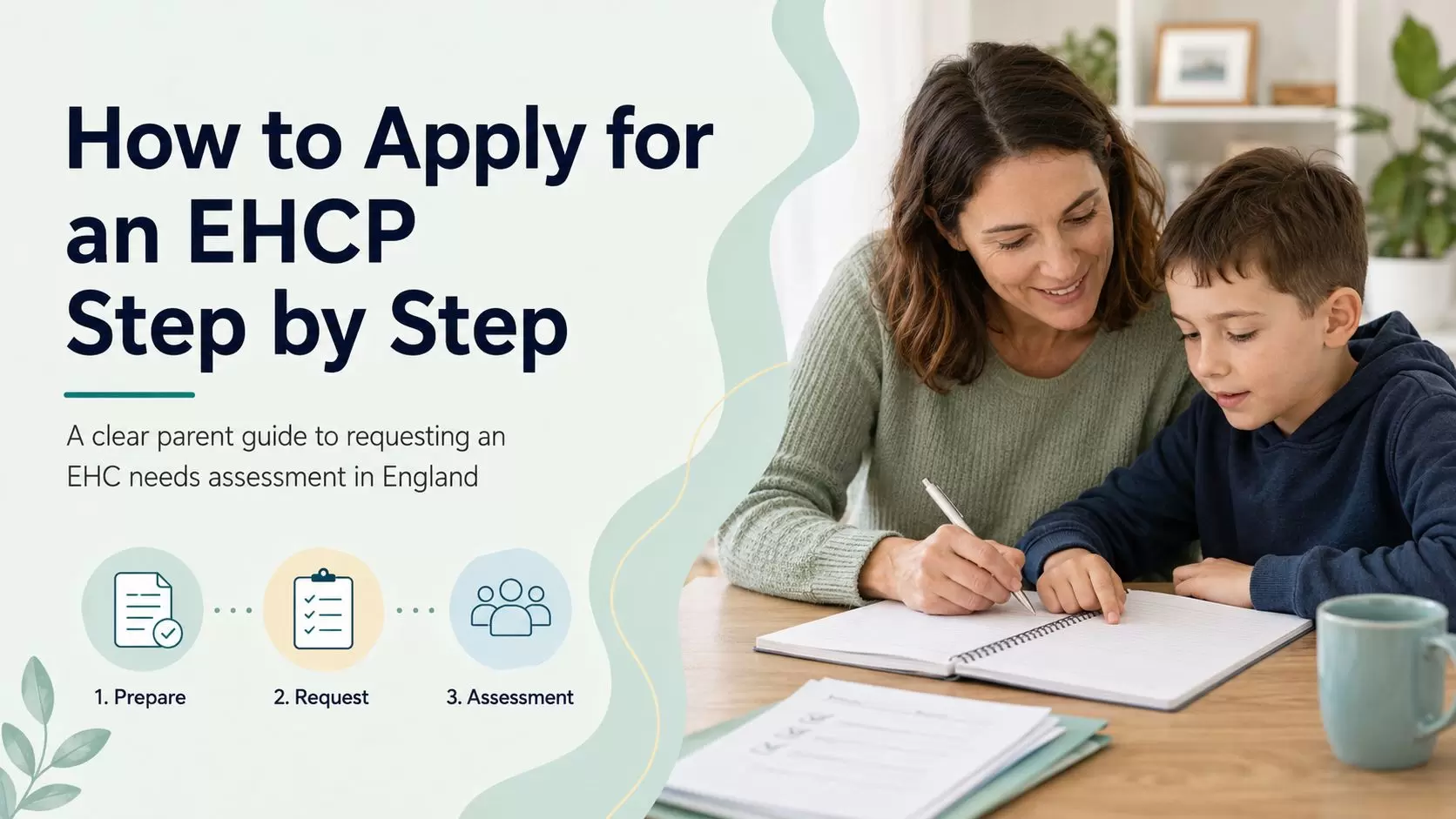
How to apply for an EHCP step by step
Step 1: Identify the correct local authority
The request should normally be sent to the local authority responsible for your child.
Search the council’s website for terms such as:
- EHC needs assessment;
- EHCP request;
- SEND team;
- statutory assessment team; or
- local offer.
Most councils provide an email address, online form or postal address for assessment requests.
Some councils encourage parents to complete a particular form. Using the form may help ensure that the council receives the information it expects, but your written request should still clearly state that you are requesting an EHC needs assessment under section 36 of the Children and Families Act 2014.
Keep a copy of everything you submit.
Step 2: State clearly that you are requesting an assessment
Your request should use direct wording.
For example:
I am writing as the parent of [child’s full name] to request an Education, Health and Care needs assessment under section 36 of the Children and Families Act 2014.
Avoid sending an email that only asks for advice about whether your child might qualify.
You want the local authority to understand that you are making a formal request and that the statutory process should begin.
Step 3: Provide your child’s essential details
Include:
- your child’s full name;
- date of birth;
- home address;
- current nursery, school or college;
- year group;
- your name;
- your relationship to the child;
- your address;
- telephone number; and
- email address.
Where relevant, also provide:
- your child’s unique pupil number, if known;
- details of any previous setting;
- whether your child is currently out of school;
- whether your child has recently moved between local authorities; and
- whether there are any urgent safeguarding, attendance or transition concerns.
Step 4: Describe your child’s special educational needs
Give a clear description of the difficulties your child experiences.
Organising the information under the four broad areas of need may help.
Communication and interaction
This may include:
- understanding spoken language;
- expressing needs;
- social communication;
- interpreting other people’s intentions;
- forming and maintaining relationships;
- communicating distress;
- processing verbal instructions;
- selective or situational mutism;
- literal interpretation; or
- needing visual or alternative communication support.
Cognition and learning
This may include:
- literacy;
- numeracy;
- memory;
- processing speed;
- attention;
- executive functioning;
- organisation;
- working independently;
- generalising learning;
- specific learning differences; or
- uneven patterns of attainment.
Social, emotional and mental health
This may include:
- anxiety;
- emotional regulation;
- school-related distress;
- avoidance;
- low self-esteem;
- difficulty managing demands;
- challenging or distressed behaviour;
- withdrawal;
- self-injurious behaviour;
- difficulty recovering from incidents; or
- significant changes in presentation between home and school.
Sensory and physical needs
This may include:
- sensitivity to noise, light, touch, smell or movement;
- sensory-seeking behaviour;
- coordination difficulties;
- fine or gross motor needs;
- fatigue;
- mobility;
- toileting;
- eating;
- sleep-related effects;
- medical needs; or
- difficulty managing the physical school environment.
Do not feel that you must fit every difficulty neatly into one category. Many children have needs that overlap several areas.
Step 5: Explain the impact on education
Do not only list diagnoses, traits or difficulties. Explain what those needs mean for your child’s access to education.
For example:
- Does your child struggle to enter or remain in the classroom?
- Can they understand and follow instructions?
- Can they start and complete work independently?
- Do they require repeated adult prompting?
- Can they communicate when they are confused or distressed?
- Do sensory demands prevent them from concentrating?
- Do they experience distress before or after school?
- Are they missing lessons or school days?
- Are they able to participate in unstructured times?
- Can they manage transitions between rooms, teachers or activities?
- Are they making progress from their individual starting point?
- Is their current attendance affecting learning?
- Are they becoming increasingly dependent on adults?
- Is their emotional wellbeing deteriorating?
- Can they access the full curriculum?
- Are they able to learn safely and consistently?
Use specific examples wherever possible.
Instead of writing:
My child struggles with school.
You could write:
My child becomes overwhelmed by noise, transitions and unpredictable changes. They frequently leave the classroom, are unable to process verbal instructions when distressed and require an adult to help them regulate before they can return to learning.
Specific descriptions help the local authority understand the nature, frequency and severity of the difficulty.
Step 6: Describe the support already tried
Explain what the nursery, school or college has already put in place.
This might include:
- SEN Support;
- Assess, Plan, Do, Review cycles;
- individual support plans;
- small-group teaching;
- one-to-one adult support;
- visual timetables;
- movement or sensory breaks;
- a reduced timetable;
- differentiated work;
- pastoral support;
- emotional literacy support;
- speech and language interventions;
- occupational therapy strategies;
- literacy or numeracy interventions;
- a quiet working space;
- support at transitions;
- home-school communication;
- behaviour support;
- attendance plans; or
- external professional advice.
Where possible, explain:
- how often the support was provided;
- who delivered it;
- how long it was tried;
- whether it was delivered consistently;
- what progress was expected;
- what progress occurred; and
- what difficulties remain.
A simple list of interventions may not show whether those interventions were sufficient.
Step 7: Explain why an assessment may be necessary
Connect the evidence to the legal test.
You could explain that an assessment may be necessary because:
- your child’s needs are significant or complex;
- existing support has not produced sufficient progress;
- professionals do not yet fully understand your child’s needs;
- specialist assessments are required;
- support needs to be coordinated across education, health and social care;
- the provision required may be beyond ordinarily available SEN Support;
- your child needs long-term, specific and legally enforceable provision;
- your child’s placement may need to be considered;
- your child is approaching an important transition; or
- the present situation is not sustainable.
You do not have to design the final EHCP at this stage. Your task is to explain why a full assessment may be required.
Step 8: Include your child’s views
Your child’s views should be included in a way that is appropriate to their age, understanding and communication needs.
You might describe:
- what they enjoy;
- what they find difficult;
- what makes them feel safe;
- what causes distress;
- what helps them learn;
- how they feel about school;
- their friendships;
- their hopes for the future; and
- what they would like adults to understand.
Your child may communicate their views through:
- writing;
- drawings;
- photographs;
- symbols;
- recorded speech;
- supported conversation;
- observations;
- a communication device; or
- a parent explaining their known preferences and presentation.
A child should not be pressured to answer direct questions where this causes distress.
Step 9: Attach supporting evidence
Attach evidence that helps demonstrate your child’s needs, the impact on education and the support required.
You do not need to submit every document your child has ever received. Select evidence that is relevant and explain what each document demonstrates.
Create a numbered evidence list so the local authority can navigate the documents easily.
For example:
- Parent statement dated [date].
- SEN Support plan dated [date].
- Educational psychologist’s report dated [date].
- Attendance record covering [dates].
- Speech and language therapy report dated [date].
- School correspondence dated [date].
- Child’s views dated [date].
What Evidence Do I Need for an EHCP?
Step 10: Send the request and keep proof
Send the request using the method specified by the local authority.
Where possible:
- use email or an online system that produces confirmation;
- request an acknowledgement;
- save the sent email;
- download a copy of any online form;
- retain all attachments;
- record the date the request was received; and
- keep all future correspondence in one folder.
The date the local authority receives the request is important because statutory timescales run from that point.
If you post the request, consider using a tracked service and retain proof of delivery.
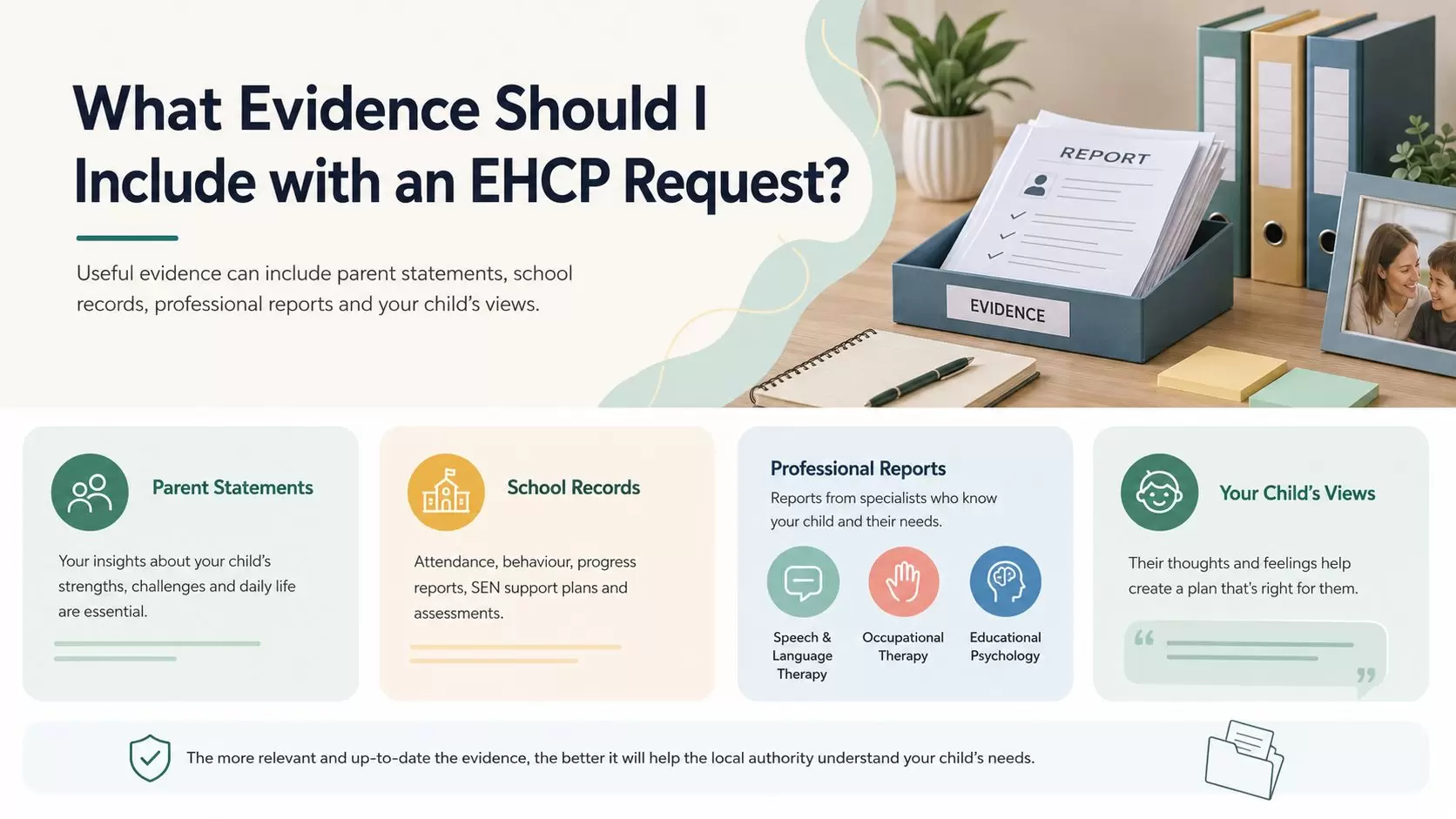
What evidence should I include with an EHCP request?
Useful evidence can include the following.
Parent evidence
Parents often hold important information about:
- early development;
- needs at home;
- preparation for school;
- recovery after school;
- sleep;
- eating;
- personal care;
- safety;
- communication;
- anxiety;
- masking;
- emotional regulation;
- independence;
- relationships; and
- the cumulative impact of the school week.
A detailed parent statement can connect information from different reports and explain your child’s daily lived experience.
[INTERNAL LINK: How to Write a Parent Statement for an EHCP]
Useful evidence can include the following.
Educational evidence
This may include:
- SEN Support plans;
- Assess, Plan, Do, Review records;
- individual education plans;
- school reports;
- attainment and progress data;
- provision maps;
- intervention records;
- behaviour records;
- attendance records;
- suspension or exclusion letters;
- reduced timetable arrangements;
- pastoral records;
- examples of work;
- home-school communication; and
- correspondence with the SENCO.
Professional reports
This may include reports or letters from:
- an educational psychologist;
- a clinical or chartered psychologist;
- a paediatrician;
- a psychiatrist;
- a speech and language therapist;
- an occupational therapist;
- a physiotherapist;
- a specialist teacher;
- CAMHS;
- a GP;
- a social worker;
- an autism assessment team;
- an ADHD assessment service; or
- other professionals involved with your child.
Reports are most helpful when they clearly identify:
- needs;
- the impact of those needs;
- recommended provision;
- frequency;
- duration;
- staffing or expertise;
- group size;
- monitoring arrangements; and
- expected outcomes.
Evidence from daily life
You may also include:
- a short diary of difficulties;
- examples of school-related distress;
- records of sleep disruption;
- records of missed education;
- photographs, where appropriate;
- communication logs;
- a timeline of significant events;
- examples of work your child could not complete;
- records of calls from school; and
- notes showing the support parents provide before and after school.
Keep this evidence factual, relevant and respectful of your child’s privacy and dignity.
Do I need every professional assessment before applying?
No.
You should provide the evidence currently available, but the purpose of an EHC needs assessment is partly to gather advice and information about your child’s needs.
Do not delay a necessary request indefinitely because:
- an NHS waiting list is long;
- an autism or ADHD assessment has not been completed;
- the school has not arranged an educational psychology assessment;
- a therapy service has not yet assessed your child; or
- you do not have a specific report.
Explain which areas remain unassessed and why further specialist advice may be required.
Can the council insist that the school applies?
A local authority should not refuse to consider a valid parental request merely because the school did not submit it.
Parents have the right to request an EHC needs assessment directly.
The authority may contact the school for information and will consider evidence from the setting, but the request does not have to originate from the school.
If you are told verbally that only the school can apply, ask for that statement and the legal basis for it in writing.
Can the council insist that I use its form?
Many local authorities provide their own assessment request form.
Completing it can be useful because it may prompt you to provide relevant information. However, the most important point is that your communication clearly constitutes a request for an EHC needs assessment and contains enough information for the local authority to identify your child and consider the request.
Where practical, use the council’s form and attach a fuller parent request letter or statement if the form does not provide enough space.
Do not allow the form’s boxes to prevent you from explaining your child’s needs properly.
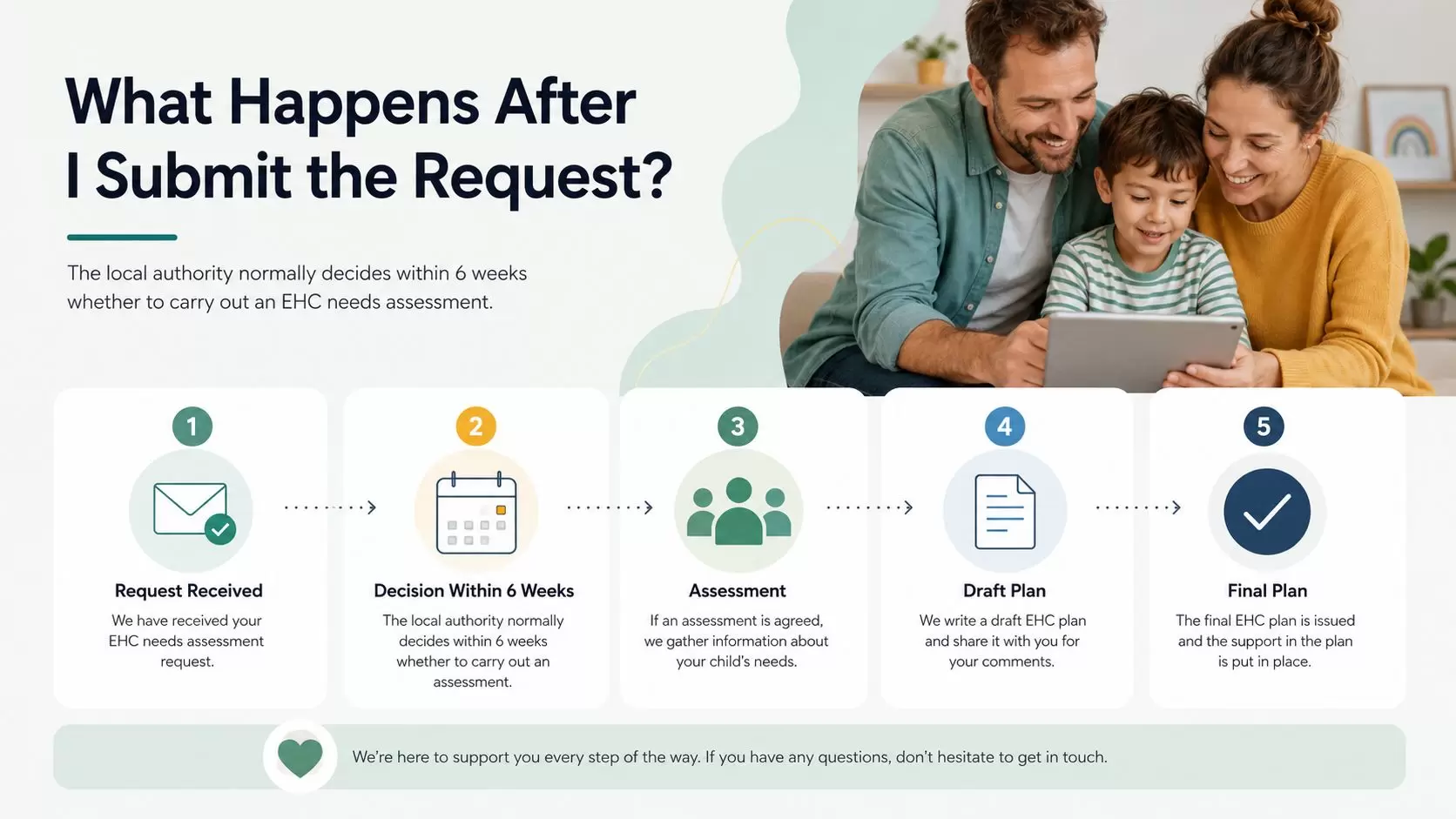
What happens after I submit the request?
The local authority acknowledges the request
The authority should identify the date it received the request and begin considering whether an assessment is necessary.
It may seek information from:
- you;
- your child;
- the nursery, school or college;
- health professionals;
- social care;
- educational professionals; and
- others involved with your child.
The local authority decides whether to assess
The local authority must notify you of its decision about whether it will carry out an EHC needs assessment within six weeks of receiving the request.
The first statutory deadline
The local authority normally has a maximum of six weeks from receiving the request to tell you whether it has agreed to carry out an EHC needs assessment.
Record the date your request was received and calculate the six-week deadline.
If the authority agrees, the assessment process moves forward.
If it refuses, it must notify you and explain your right to challenge the decision.
What happens during an EHC needs assessment?
The local authority gathers advice and information about your child’s education, health and social care needs.
The assessment should consider:
- your views and evidence;
- your child’s views, wishes and feelings;
- educational needs;
- health needs connected with SEND;
- social care needs connected with SEND;
- desired outcomes;
- special educational provision;
- health provision;
- social care provision; and
- preparation for adulthood where appropriate.
The authority may seek advice from:
- your child’s educational setting;
- an educational psychologist;
- health professionals;
- social care;
- specialist teachers;
- speech and language therapy;
- occupational therapy;
- other relevant professionals; and
- any person you reasonably request the authority to seek advice from, where applicable.
The assessment should not merely collect diagnoses. It should identify your child’s needs, the outcomes sought and the provision required.
Does an assessment automatically result in an EHCP?
No.
After completing the assessment, the local authority must decide whether it is necessary for special educational provision to be made in accordance with an EHC plan.
If it decides that a plan is necessary, it will prepare and send you a draft EHCP.
If it decides not to issue a plan, it must tell you and explain your rights to challenge that decision.
What is the EHCP application timeline?
The standard process is normally as follows.
Week 0: The request is received
The statutory process begins when the local authority receives the request for an EHC needs assessment.
By week 6: Decision whether to assess
The local authority must normally tell you whether it will carry out the assessment within six weeks.
By week 16: Decision whether to issue a plan
Following the assessment, the local authority should normally decide and notify you whether it will issue an EHC plan by week 16.
Where it agrees to issue a plan, it sends a draft EHCP.
Draft EHCP consultation
You must be given at least 15 days to:
- comment on the draft;
- request amendments;
- express a preference for a school or other educational setting; and
- request a meeting with the local authority if necessary.
By week 20: Final EHCP
Where the local authority decides to issue a plan, the complete process should normally take no more than 20 weeks from the date the assessment request was received.
Limited statutory exceptions can apply in particular circumstances.
Keep your own EHCP timeline
Do not rely entirely on the local authority to remind you of deadlines.
Record:
- the date your request was received;
- the six-week decision deadline;
- the date the assessment was agreed;
- the week-16 decision point;
- the date the draft was received;
- the deadline for your comments; and
- the week-20 final-plan deadline.
What should I do when I receive the draft EHCP?
Read every section carefully.
Pay particular attention to:
- Section A: your child’s and family’s views, interests and aspirations;
- Section B: all identified special educational needs;
- Section E: outcomes;
- Section F: special educational provision;
- Section G: health provision reasonably required by the child’s SEN;
- Sections H1 and H2: relevant social care provision;
- Section I: named placement or type of placement;
- Section J: personal budget arrangements; and
- Section K: advice and reports used during the assessment.
Section F is especially important because the special educational provision should be clear, detailed and specific.
Be cautious about vague wording such as:
- access to;
- opportunities for;
- as required;
- when necessary;
- regular;
- frequent;
- appropriate support;
- small-group work; or
- support from an adult.
Where possible, provision should identify:
- what will be delivered;
- who will deliver it;
- their required expertise;
- how often it will happen;
- the length of each session;
- whether it is individual or group provision;
- maximum group size;
- where it will take place;
- how progress will be monitored; and
- how the provision will be reviewed.
What if the local authority refuses to assess?
A refusal does not necessarily mean that your child does not need an assessment.
Read the decision letter carefully and check:
- the reasons given;
- whether the correct legal test appears to have been applied;
- whether all your evidence was considered;
- whether the authority placed too much emphasis on attainment;
- whether it wrongly required a diagnosis;
- whether it said the school must do more without addressing your child’s current needs;
- whether it properly considered progress, attendance, wellbeing and access to education; and
- whether the authority imposed a higher threshold than the law requires.
You may have a right to appeal the refusal to the First-tier Tribunal (Special Educational Needs and Disability).
Before registering most SEND appeals, you will normally need to contact a mediation adviser and obtain a mediation certificate. You do not necessarily have to participate in mediation, but you should follow the instructions and deadlines in the decision letter.
Appeal deadlines are important. Act promptly and obtain individual advice where necessary.
What if the local authority agrees to assess but refuses to issue an EHCP?
The authority may complete the assessment but decide that an EHC plan is not necessary.
It should provide its decision and explain your right to challenge it.
Review:
- the professional advice gathered;
- whether all identified needs have been included;
- whether recommendations demonstrate that provision beyond ordinary SEN Support is required;
- whether the authority has explained how the setting can provide the recommended support;
- whether the evidence supports coordinated or specialist provision;
- whether your child has made sufficient progress; and
- whether the current arrangements are sustainable.
You may have a right to appeal the refusal to issue an EHC plan.
Common mistakes when applying for an EHCP
Waiting for the school to apply
A parent can make the request directly. Do not assume that only the school can begin the process.
Waiting for a diagnosis
The legal test concerns special educational needs and whether provision through an EHC plan may be necessary. A diagnosis is not required before requesting an assessment.
Describing labels without explaining impact
State how your child’s needs affect access to learning, attendance, communication, wellbeing and independence.
Providing evidence without explaining it
Summarise what each important report or document demonstrates.
Focusing only on academic attainment
Include emotional, sensory, communication, social, attendance, physical and independence needs.
Using only general statements
Give specific, recent examples that show frequency, severity and impact.
Failing to explain what has already been tried
Describe the support provided, how consistently it was delivered and what happened as a result.
Not keeping proof of submission
Retain copies of the request, evidence, acknowledgement and receipt date.
Missing statutory deadlines
Create your own timeline and follow up in writing where a deadline is missed.
Understating your child’s difficulties
Parents often become accustomed to providing extensive support. Explain what happens without that support and what is required to keep your child functioning.
EHCP application checklist
Before sending your request, check that you have included:
A clear request for an EHC needs assessment.
Reference to section 36 of the Children and Families Act 2014.
Your child’s full name and date of birth.
Your child’s address and educational setting.
Your contact details.
A description of your child’s special educational needs.
Examples showing the impact on education.
Information about attendance and access to learning.
Details of support already tried.
Information about progress and remaining difficulties.
Your child’s views.
Your views as a parent.
Relevant educational evidence.
Relevant professional reports.
An explanation of why an assessment may be necessary.
A numbered list of attachments.
A request for written acknowledgement.
A saved copy of the complete submission.
Example wording for an EHCP assessment request
The following wording can be used as the beginning of your request:
Dear Sir or Madam,
I am writing as the parent of [child’s full name and date of birth] to request an Education, Health and Care needs assessment under section 36 of the Children and Families Act 2014.
I believe that my child has or may have special educational needs and that it may be necessary for special educational provision to be made in accordance with an EHC plan.
My child currently attends [name of setting] and is in [year group]. They experience needs relating to [briefly identify the main areas of need].
These needs affect their education by [briefly describe the main impact on learning, attendance, communication, regulation, wellbeing or independence].
Support has already included [summarise the support tried]. Despite this, [explain the continuing difficulties or lack of sufficient progress].
I have enclosed evidence in support of this request and ask that you confirm the date on which the request was received.
Yours faithfully,
[Parent’s name]
Your full letter should provide more detail about your child’s needs, the support already tried and why an assessment may be necessary.
What happens during an EHC needs assessment?
Parents often describe this process as “applying for an EHCP”. However, the formal first step is to request an EHC needs assessment.
The assessment is used to identify your child’s education, health and social care needs and the special educational provision they may require.
Following the assessment, the local authority decides whether it is necessary to issue an EHC plan.
A request for an assessment does not automatically result in an EHCP. However, the local authority must consider your request using the correct legal test.
How School of Diversity can help
Applying for an EHCP can involve bringing together educational records, professional reports, parent evidence and information about your child’s daily needs.
School of Diversity supports parents at different stages of the EHCP process, including:
- deciding whether an EHC needs assessment request may be appropriate;
- reviewing existing evidence;
- identifying gaps in an application;
- helping parents structure their request;
- preparing parent statements;
- reviewing draft EHCPs;
- strengthening Sections B and F;
- preparing for annual reviews;
- responding to refusals;
- mediation support;
- working-document support; and
- SEND Tribunal preparation.
Our aim is to help you explain your child’s needs clearly and ensure that important evidence is not overlooked.

Join the free School of Diversity Parent Membership
Parents can also join our free membership programme for practical SEND guidance and resources.
Membership includes support and information relating to:
- SEND;
- EHCPs;
- ADHD;
- autism;
- dyslexia;
- dyscalculia;
- DLA applications;
- support at home;
- support at school;
- support in public places; and
- supporting children and young people online.
Select the category that best fits your family and access practical guidance in one place
Frequently asked questions about applying for an EHCP
What is the first step in applying for an EHCP?
The first formal step is to ask your local authority to carry out an Education, Health and Care needs assessment. A parent can submit this request directly.
Do I apply to the school or the local authority?
The formal request is made to the local authority responsible for your child. The school can submit a request, but parents can also apply directly.
Does the school have to agree to an EHCP application?
No. A parent does not need the school’s permission to request an EHC needs assessment. The local authority will usually seek information from the school when considering the request.
Does my child need a diagnosis?
No. A diagnosis is not required. The decision should focus on whether your child has or may have special educational needs and whether provision through an EHC plan may be necessary.
Can I apply if my child has good grades?
Yes. Academic attainment is only one part of the evidence. A child may achieve academically while experiencing substantial communication, sensory, emotional, attendance, regulation or independence needs.
Can I apply if my child is not attending school?
Yes. Difficulties attending school may be important evidence of unmet need. Explain the reasons for non-attendance, its impact and what support has been attempted.
Can I apply for an EHCP for a child under five?
Yes. An EHC needs assessment can be requested for a young child where the statutory test may be met. Evidence may come from parents, early-years settings, health visitors, paediatricians, therapists and other professionals.
Can I apply if my child is home educated?
Yes. A child does not have to attend a school for a parent to request an EHC needs assessment.
How long does the council have to respond?
The local authority should normally tell you whether it will carry out an EHC needs assessment within six weeks of receiving the request.
How long should the full EHCP process take?
Where an assessment leads to an EHC plan, the overall process should normally be completed within 20 weeks of the local authority receiving the assessment request, subject to limited statutory exceptions.
What happens if the council misses the six-week deadline?
Follow up in writing, identify the date the request was received and ask for an immediate decision. Keep a record of all correspondence and consider obtaining specialist advice if the delay continues.
Can I appeal if the assessment is refused?
Yes. Parents and eligible young people generally have a right of appeal to the First-tier Tribunal against a refusal to carry out an EHC needs assessment. Follow the appeal and mediation instructions in the decision letter and act within the stated deadline.
What happens if the council assesses but refuses to issue a plan?
You may have a right to appeal the refusal to issue an EHC plan. Review the assessment evidence carefully and obtain advice about the reasons given.
Should I use the council’s EHCP request form?
It is often helpful to use the local authority’s form, but you can attach a detailed parent letter or statement where the form does not provide enough room to explain your child’s needs.
Do I need a solicitor to apply for an EHCP?
No. Parents can make an EHC needs assessment request themselves. Some parents choose to obtain SEND advocacy or legal advice where the evidence is complex, a request has been refused or an appeal is being considered.
What is the difference between SEN Support and an EHCP?
SEN Support is arranged by the educational setting using the resources and provision normally available to it. An EHCP is a statutory plan that identifies needs, outcomes and provision and places legal duties on the local authority regarding the specified special educational provision.
Final thoughts
You do not need to wait for your child to reach crisis point before requesting an EHC needs assessment.
A strong request should:
- identify your child’s needs;
- explain how those needs affect education;
- describe the support already tried;
- show what difficulties remain;
- include relevant evidence; and
- explain why a full assessment may be necessary.
The legal threshold at the assessment-request stage is not that you must prove an EHCP is definitely required. The local authority must consider whether your child has or may have special educational needs and whether it may be necessary for provision to be made through an EHC plan.
Keep your request clear, evidence-based and focused on your child’s individual needs.
Related EHCP guidance
- [INTERNAL LINK: What Is an EHCP?]
- Does My Child Need an EHCP?
- SEN Support Versus an EHCP
- What Evidence Do I Need for an EHCP?
- EHCP Without a Diagnosis
- How Long Does an EHCP Take?
- EHC Needs Assessment Process
- EHCP Refused – What Next?
- How to Appeal a Refusal to Assess
- EHCP Sections Explained
- How to Strengthen Section F
- Draft EHCP Review Support
- SEND Tribunal Support
Sources and legal references
This guide should be read alongside the current law and statutory guidance applicable in England:
- Children and Families Act 2014, particularly section 36.
- Special Educational Needs and Disability Regulations 2014.
- SEND Code of Practice: 0 to 25 years.
- GOV.UK guidance on special educational needs and Education, Health and Care plans.
Important information
This article provides general information about the EHCP process in England. It does not constitute legal advice and should not be treated as a substitute for advice based on the individual circumstances of your child or case.
Written by: School of Diversity SEND Support Team
Professionally reviewed by: Joanne Wright Chartered and Registered Psychologist
Last reviewed: June 2026
Next review due: December 2026